


THE SET-UP: Kevin Hassett just had a week that mirrors the bifurcating economy he perpetually sells with his Cheshire Cat-like smile.
Trump’s Director of the National Economic Council first tried to spin a surge in credit card “spending” as a proof that the economy is doing great.
It is “through the roof,” gushed Hassett.
Although Hassett called it “credit card spending,” it’s more accurately called “debt spending.” Even better is “debt accumulation.” And, of course, that’s what’s actually happening when people buy perishables and necessities that quickly zero-out in value when they are purchased, let alone consumed. The unavoidable truth is people are increasingly going into debt to pay for stuff they previously paid for outright, either on the spot or at the end of the month. Hassett unintentionally made that point in the same breath: “They’re spending more on gasoline, but they’re spending more on everything else too.”
He also predicted the then-forthcoming jobs report would echo the economic strength he somehow sees in people running-up their credit cards. Indeed, he was right about the jobs report exceeding expectations, with a 115k jobs created instead of an estimated 67k jobs. But, as an analysis in Yahoo!Finance makes clear, the scenario is not quite as rosy as Hassett’s grinning gob might lead some to believe.
Like all of Trump’s apple-polishers, Hassett speaks glowingly of the stock market, particularly when confronted with persistent economic concerns. Those record highs, though, reveal the K-shaped reality Hassett & Co. continue to ignore:
Tech stocks are trading at an all-time high relative to the S&P 500. At the same time, tech jobs — using BLS information payrolls as a proxy — have fallen to an all-time low as a share of total US payrolls.
Yahoo!Finance then cited this graph by the head of macro research and strategy for the Schwab Center for Financial Research:
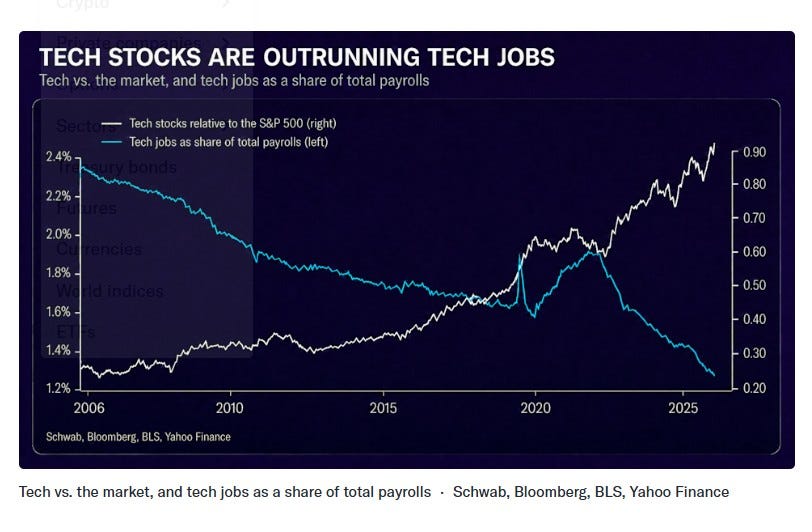
There it is, folks—the “K” of K-shaped economics. The rich and the rest are going to two opposite directions. And it is in full-bloom in the one segment of the economy that is “booming.”
But it is really “booming,” or it is “hoarding”?
A booming economy would distribute the gains. The rest might not be getting rich, but they certainly wouldn’t be losing ground. Nor would they be increasingly locked-out of opportunities to earn an income in the one segment of the economy enjoying the most investment. As the graph illustrates, that’s exactly what’s happening.
A.I.-driven tech may be the ultimate K-shaped industry.
If the investments are successful, the jobs it creates in the near-term future may simply be recast as tasks for A.I.’s growing to-do list. And should A.I. spark the “revolution” productivity, the humans still hanging on to mid-level tech jobs will soon become superfluous.
Whether it’s the latter … or the former … or both … that’s more purchasing power drained from those on the K’s leg. It underscores the self-reinforcing nature of K-shaped economics. The more wealth and capital accumulates at the top, the more they can consume. They can then pay twenty bucks for a strawberry or seven bucks for a gallon of gas. And they can spend enough to effectively hide the struggles of millions of Americans in aggregate economic data like GDP … for now.
In the long-term, it could be that draining income and purchasing power from the K’s leg will finally create too heavy of a lift for the asset-rich arm. If the K-shape spreads and deepens through the economy, the arm may ultimately fail to prop-up a big aggregate measurement like GDP.
It appears we’re going to find out because the shape of things to come keeps coming up “K.”
For example, the day after Hassett’s much-ridiculed crowing about credit cards, the Federal Reserve Bank of New York released a detailed study that found the K popping-up in retail gasoline sales:
[T]hree income categories had very different experiences during the March 2026 energy price shock. Low-income households increased their nominal gas spending by the least (12 percent). However, this was accomplished because they cut their real gas consumption the most (7 percent). On the other hand, high-income households increased their nominal gas spending by the most (19 percent) in a large part because they reduced their real gas consumption the least (1 percent). Middle-income households had intermediate increases in nominal spending and decreases in real consumption at gas stations. Thus, the K-shaped consumption pattern in both nominal and real gasoline spending was strongly evident in March 2026.
It just stands to reason, given the research we’ve already seen on K-shaped consumer spending. The divide between the investor class and income earners is clear. A.I. tech is driving it, but it is a temporary anomaly or deviation of the post-Covid age? Is it something that will pass if (or when) the A.I. bubble pops?
Or is this bifurcation taking root here and around the world as globalization is methodically trumped by Silicon Valley’s technofeudal business model?
One thing is clear from the jobs report … the jobs the economy is making are service jobs and, in particularly, jobs that have lower income humans servicing the needs of higher income humans. CNN noted that “healthcare and social assistance – an industry buoyed by an aging population – was once again a leading driver of job gains.”
“Once again” was “a leading driver of job gains.” Not tech, where it’s projected $2.5 trillion will be invested this year alone. And Trump’s manufacturing boom is a bust. No, the jobs are lower-paying jobs taking care of aging, infirm Baby Boomers. That and teaching the kids of people who can afford private instruction:
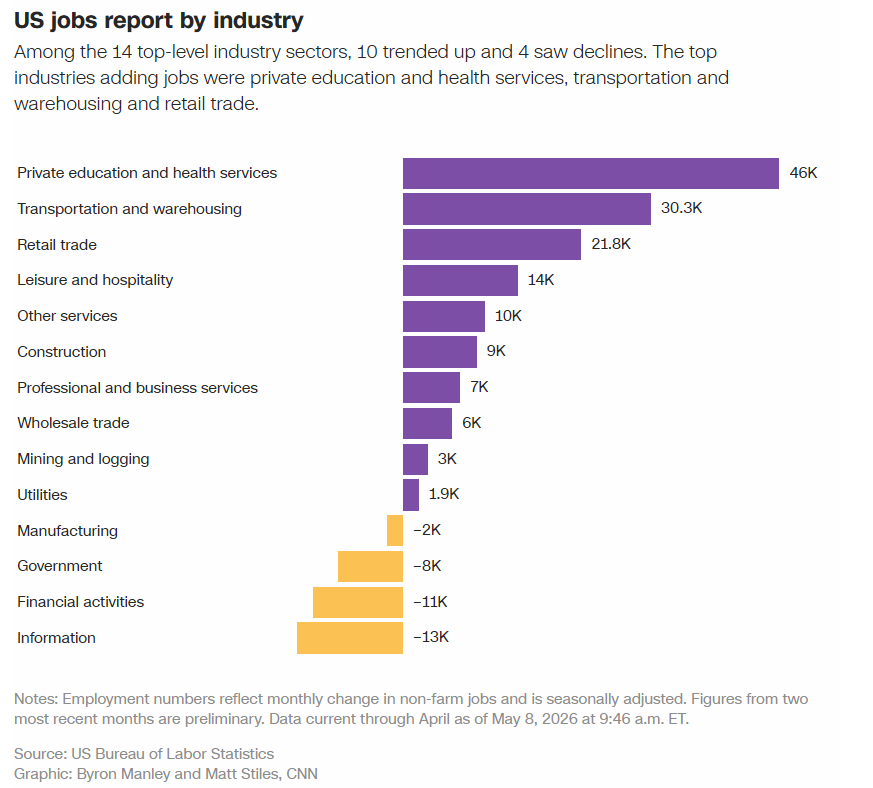
The top four industries do not promise a middle class lifestyle. Maybe transportation and warehousing, although those are both destined to be automated by A.I. and humanoid robots. And look at where those mid-level, college degree-dependent jobs are going!
Frankly, that chart has the K-shaped economy written all over it and it’s going to cost us an arm and a leg. - jp
Southern California’s K-shaped summer: Who’s traveling depends on the pocketbook
https://www.ocregister.com/2026/05/02/southern-california-summer-travel-high-costs-will-keep-some-close-to-home/
With food benefit cuts looming in the US, Californians eye billionaire tax
https://www.aljazeera.com/economy/2026/5/10/with-food-benefit-cuts-looming-in-the-us-californians-eye-billionaire
Guess which half of America holds 89% of the wealth
https://www.usatoday.com/story/money/2026/05/09/boomers-gen-x-american-hold-wealth/89968169007/
Trillion-Dollar Redistribution: Democratic States Transfer Wealth to Republican Areas as New York Leads Migration
https://www.ktsa.com/trillion-dollar-redistribution-democratic-states-transfer-wealth-to-republican-areas-as-new-york-leads-migration/
Americans Are Flocking To These Unexpected Midwest Suburbs As Housing Affordability Cracks Major Cities
https://www.benzinga.com/real-estate/26/05/52363267/americans-are-flocking-to-these-unexpected-midwest-suburbs-as-housing-affordability-cracks-major-cities
AI is quietly splitting the housing market in two: Bay Area luxury homes are up 13%, affordable ones are collapsing
https://fortune.com/2026/05/07/ai-bay-area-housing-luxury-homes-affordability-redfin/