


THE SET-UP: When a young woman in United States buys one of the 2,000 new items ultra-fast fashion giant Shein posts daily on its market-dominating online store, there is a chance it will eventually be packed into a 120 pound bale of discarded clothing and carried into Accra’s Kantamanto market on the head of another young woman struggling to eke out a living in Ghana’s capital city.
Known colloquially as kayayei—which literally means “head porters”—the women are expected to navigate the narrow alleys of the tightly-packed market and deliver the bales to one of the market’s many retailers … all for less than $1 per day.
Atmos recently profiled a kayayo named Najiha Yahaya. She left her home in a rural farming community at age 15 in the hope she could “earn just enough money for books and a school uniform before returning home.” Soon after arriving in Accra, Yahaya joined the ranks of roughly a thousand women who toil in “one of the largest secondhand clothing markets in the world,” often at the expense of their physical health:
Carrying things on one’s head has been the norm in Ghana for millennia, but the routine expectation that kayayei should be able to haul dangerously heavy loads multiple times a day in the secondhand clothing market is something else entirely.
Beyond noticing pain, most kayayei aren’t aware of what head-carrying is doing to their bodies. So in 2021, The Or Foundation set out to try quantifying those health impacts. The organization brought 100 kayayei between the ages of 12 and 40 to see Dr. Naa Asheley Ashietey, a chiropractor who X-rayed all the participants and provided a basic health screening.
What Ashietey saw deeply alarmed her. The burden these girls and women had borne was etched into their bones. She saw teenagers and young women whose spines had degenerated so severely that they looked like they belonged to someone decades older. Some had developed bone spurs. Others had discs so worn down that their spinal bones were literally rubbing against one another, pinching nerves and causing intense pain. Others still had lost the natural curve in their neck and spine, or conversely, developed scoliosis. Many sustained foot injuries, too, from tripping while carrying heavy loads.
The physical toll is compounded by the psychological abuse they endure as internal migrants from Ghana’s rural north:
“People really abuse them in the market because they are a minority,” said Mambaru Mustapha, who works on a scholarship for kayayei created by the nonprofit The Or Foundation, an environmental justice organization that works extensively with kayayei. “People literally call them animals.”
Despite it all, women still go to the market in search of a subsistence living. Yahaya doesn’t think they have much of a choice:
“It’s something I don’t think anybody will wish to be doing,” Yahaya told Atmos, describing it as an option women take up when the only other alternatives they can see are stealing or sex work. “Head porting is a slavery.”
The profile’s author, Whitney Bauck, admitted that the comparison between slavery and head porting “can feel jarring, especially considering the long, grim shadow that chattel slavery still casts on both sides of the Atlantic.” But, with that said:
[T]he comparison to slavery is one that you hear over and over when you spend time talking to kayayei, former kayayei, and the people who advocate for them. Some girls are literally trafficked, lured to Accra by an agent who promises good jobs and then keeps all the money the girls earn, effectively entrapping them without resources hundreds of miles from their families.
And Bauck thinks it’s no coincidence that “a fashion system built on excess, in which companies and governments in the Global North export their waste to the Global South and pass it off as charity,” is replicating an “extractive dynamic” that “echoes throughout fashion’s history”:
In the 18th and 19th centuries, African labor was exploited at the beginning of the supply chain on cotton farms in the Americas; in the 21st, African labor is being exploited at the end of the supply chain to handle textile waste. The names have changed, but a business model built on human rights abuses remains.
…and…
This, perhaps, is where the troubling comparison to slavery that Yahaya and so many others make starts to feel most apt. Though the system harming kayayei is barbed by the disregard and discrimination of their fellow Ghanaians at home, it’s ultimately fed by a giant monster of capitalism designed to enrich wealthy people, mostly in the Global North, without whom the system wouldn’t exist in the first place. Whether it’s garment workers in Bangladesh dying in unsafe factories, forests in Brazil dying to clear space for leather-producing farms, or kayayei dying under the burden of textile waste, the modern fashion industry has built its record-breaking profits on treating some lives as disposable.
The standard-bearer of fashion’s disposability-driven business model is, of course, the aforementioned Shein. Long dogged by troubling labor practices that include child labor, it has seen meteoric growth over the last decade with its ultra-fast model that entices consumers with a non-stop barrage of new products. It’s basically planned obsolescence on two levels—both in terms of quality and style. The clothes are not meant to last on either count. Shein is not alone is profiting off fast fashion’s zone-flooding approach to selling garments. Temu, Zara, H&M and Forever 21 have also capitalized on the fast or, as it’s now called, the ultra-fast fashion phenomenon that, Sustainably Chic recently noted, has humans “consuming 400% more clothing compared to 20 years ago” and, therefore, generating “82 pounds of textile waste every single year.”
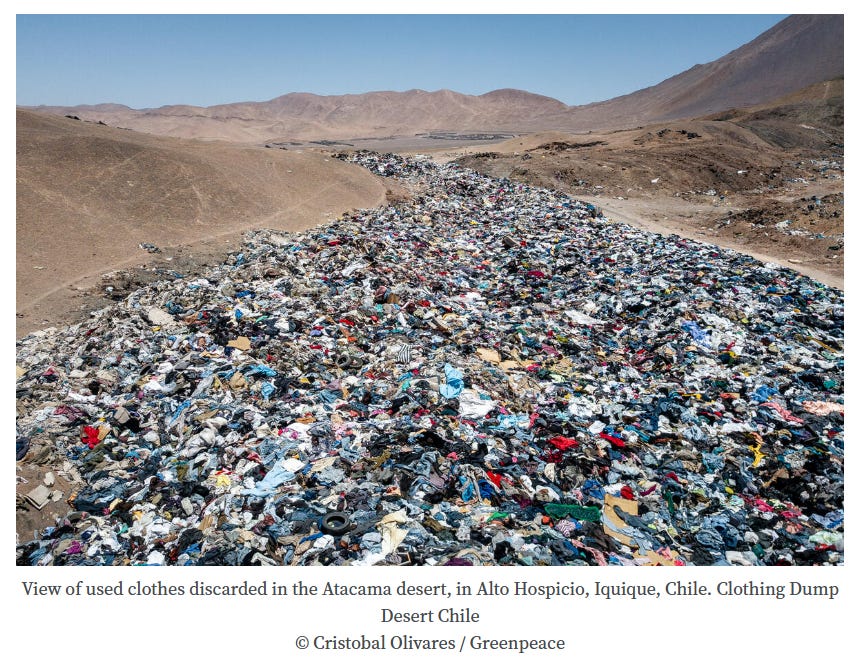
In total, humans discard more than 92 million tons of textiles annually, while only 0.3% are kept in circulation. That’s more than enough, though, to compress the spines of kayayei in Accra.
And it’s not likely to change for the foreseeable future.
In fact, the just-announced $100 million sale of “ethical,” direct-to-consumer fashion brand Everlane to ultra-fast fashion behemoth Shein is a seminal moment for the $1.84 trillion global apparel business. In the years since it launched in 2011, Everlane stood in direct opposition to the wasteful, abusive fast fashion business model that catapulted Shein to the top of the ultra-fast food chain. Here’s how Vogue described the “radically transparent” company:
Launched in 2011, Everlane came up in the age of “ethical capitalism” and millennial optimism, when the general consensus was that the most sustainable thing people could do was eat a vegan diet, boycott air travel, and put their dollars behind brands that bucked the status quo. With its promises of “radical transparency” on pricing and supply chains, Everlane was well-positioned to capitalize on this, and its elevated basics quickly gained a devoted following — not to mention a $600 million valuation at its 2020 peak.
But, as Vogue explains, it was downhill from there:
[T]he brand’s sustainability chops took a hit in 2020, when an investigation in The New York Times unraveled its promise off the back of accusations about union-busting and a tumultuous internal culture. (At the time, co-founder Michael Preysman issued a statement saying the company had “urgent work to do to rewrite Everlane’s code of ethics”.) Sales faltered, and the situation worsened when consumers started demanding more than basic designs.
New York Times fashion reporter Jacob Gallagher elaborated on that shift away from “basic designs” in a report on the acquisition that reads like an obituary for both Everlane and the era that fostered it:
Everlane’s generic staples looked right for the moment in which it thrived — one in which millennial “blanding” in advertising and fashion saw the rise of brands like Away Luggage, Warby Parker and Glossier. Everlane was more polished than normcore — more office appropriate with its roster of cashmeres and wool work trousers — but it still offered a palate of sanitized beiges, browns and grays. Covid hurt Everlane as its office-casual offering turned inessential.
Today, the “shopping sustainably” crowd congregates on Depop, where buying used clothes is considered more eco-conscious and they can find a variegated assortment of stuff. Gen Z-ers habits are driven more by finding their “personal style” than by adopting a virtue-signaling uniform.
In the end, people seem to care much less about where and how their clothes were made, or who was making them, than they did about getting a good deal.
That was echoed by MarketWatch:
Over the past decade, brands emphasizing quality, sustainability and ethical production were rewarded with legions of shoppers and sky-high valuations. Now, those same companies are struggling to survive in an era where consumers are becoming laser-focused on one shopping metric — price.
Sadly, though, the low price consumers pay in the United States is no bargain for the nearly invisible humans around the world who ultimately bear the real cost of fast and ultra-fast fashion’s planned obsolescence. That much is clear in a new report from Fashion For Good:
The human and environmental costs of today’s fashion system are well-known. The fast fashion model runs on an accelerated ‘take-make-waste’ cycle, which while highly profitable is deeply entwined with resource depletion and exploitation. Although data is scarce, some estimates suggest that less than 2% of garment workers make a living wage, with women and marginalised groups—58–80% of the workforce—the most affected. The textiles industry is responsible for 2–8% of global greenhouse gas (GHG) emissions, uses around 15,000 chemicals, consume 215 trillion litres of water annually, and contribute roughly 9% of global microplastic pollution. Despite brands’ sustainability pledges, just 0.3% of materials are kept in use or recovered through circular practices. Production is surging, with clothing consumption projected to rise 63% between 2015 and 2030. While exact outputs are rarely disclosed, estimates suggest 100–150 billion garments are produced each year, with up to 30% never being sold. This overproduction drives intensive waste generation: about 92 million tonnes of textiles are discarded annually, with 61.4% landfilled or incinerated, 6.3% recycled, and only 8% reused.
…and…
From an environmental perspective, textile waste disposal in export destinations is linked to significant environmental and health harms. The lack of waste management systems in place means that significant volumes of textiles are informally dumped or burned, with wide ranging impacts on surrounding ecosystems. Many of these adverse environmental impacts stem from the increasing prevalence of synthetic fibres in clothing. Fossil fuel-based synthetics have come to dominate global fibre production, with polyester alone now accounting for around 59% of total output, of which approximately 88% is fossil-based with polyester alone making up more than half. When discarded in unmanaged landfills or burned in the open, synthetic microfibres enter ecosystems, where they do not biodegrade and can persist in soil and marine environments for centuries Burning textiles releases heavy metals, acid gases, particulates, and dioxins into the air, contributing to a range of adverse health effects. The full range of risks posed by fibre fragment pollution remains poorly understood as they can disrupt natural systems even at trace levels. Microfibres are highly mobile, making it difficult to quantify their distribution and accumulation across air, soil, and water, with existing research focused predominantly on aquatic pathways. Natural fibres also shed significantly and can persist in the environment, and their biodegradability depends not only on material origin but on environmental conditions and the chemical and mechanical treatments applied during production. Adverse environmental impacts affect low-income and historically exploited countries where discarded textiles end up disproportionately, underscoring the relevance of a waste colonialism lens when examining the export of used textiles.
The acceleration of fast fashion to ultra-fast fashion likely sealed Everlane’s fate. While the post-covid impact of chronic inflation is clear, Shein’s business model also changed consumer expectations and desires. Consumers have been trained to expect much more for much less, thanks in no small part to Shein’s accelerated model:
Ultra-fast fashion represents a sharp escalation of the industry’s growth model, with business structures built on real-time trend responsiveness, ultra-low prices, and algorithm-driven marketing. The scale is unprecedented: in April 2022, H&M had added 4,414 new styles to its website (and Boohoo 18,343.) Meanwhile, Shein had already introduced 314,877. Shein has since become the world’s largest apparel retailer (2023–2024) and the most Googled brand globally, overtaking Nike and adidas. Such relentless product turnover undermines the potential impact of downstream circular strategies like Rewear. Without upstream measures to slow down production, Rewear becomes a parallel market that coexists with, rather than counters, the environmental damage of fast and ultra-fast fashion.
That marriage of ultra-fast fashion and resale apps like Vinted—”an online second-hand marketplace that just last week boasted of its $8bn value”—is, according to The Independent’s Esme Gordon Craig, driving more consumption:
Vinted can encourage overconsumption; its business model is fuelled, if not dependent, upon our love for impulse buying and the ease with which we discard items. The doomscrolling element of the app only amplifies this. Presenting itself in the same way as social media platforms like Instagram and TikTok enables it to wield a similarly addictive quality. I have friends who spend hours – and I mean hours – scrolling on Vinted, something I’d argue is largely driven by the app’s design.
…and…
One friend described purchases on Vinted as an “addictive dopamine hit” which “cannot be matched by normal shopping”. It can lead to the purchase of countless products we neither want nor need – too many times has a Vinted package arrived at my door that I had all but forgotten about. Even worse, when we don’t return them, these unwanted items of clothing, shoes or accessories can end up going in – you’ve guessed it – the bin.
Unfortunately, burying it in a local landfill is probably preferable to shipping it out to places like Ghana, where could end up in a 120 pound bale or as refuse despoiling Ghana’s wetlands. Frankly, there is only one real answer to this problem:
I’ve come to realise that Vinted works hand in hand with the throwaway culture that characterises many affordable retail brands. When shopping in the likes of H&M and Zara with friends, we’ll often purchase a top with the comfort of knowing that, if we decide we don’t like it, we can always sell it on Vinted.
The one true solution is to buy less.
Could we get by on 200 pounds of new clothing per year? Or 100 pounds?
Perhaps even buy well-made items sewn to last?
If not, you can pull up the Shein app and wait for the packages to roll in. If you do, keep in mind that the less your pay, the more it costs somebody else.
Reconomy Report Finds Circularity Solutions Not Meeting the Scale of Textile Waste
https://wwd.com/sourcing-journal/sustainability/report-finds-solutions-not-meeting-scale-of-waste-1238973596/
Clothes are flowing to landfills. University of Dayton students are trying to decrease the waste stream
https://www.statenews.org/section/the-ohio-newsroom/2026-05-18/clothes-are-flowing-to-landfills-university-of-dayton-students-are-trying-to-decrease-the-waste-stream
The world sends its fast fashion to this Indian city. Its residents pay a price
https://www.cnn.com/2026/05/09/india/india-panipat-textile-recycling-intl-hnk-dst
Centre rejects portrayal of India as ‘dumping ground’ for fast-fashion waste from Western countries
https://www.deccanherald.com/india/centre-rejects-portrayal-of-india-as-dumping-ground-for-fast-fashion-waste-from-western-countries-4002866
Textile waste emerges as Kenya’s new ocean crisis
https://nation.africa/kenya/climate/textile-waste-emerges-as-kenya-s-new-ocean-crisis-5457726
Fashion’s resale boom risks a new era of ‘waste colonialism’
https://www.just-style.com/features/fashions-resale-boom-risks-a-new-era-of-waste-colonialism
Everlane, Shein, and the Limits of the Ethical Consumer
https://www.theatlantic.com/culture/2026/05/everlane-shein-sale-sustainable-fashion/687218/