


House Republicans had it all planned.
After decades of futility and frustration, they were finally poised to gut the Endangered Species Act (ESA) with a bill critics dubbed “the Extinction Act.”
But winning wasn’t enough.
The architects of H.R. 1897 wanted to pass the bill on Earth Day, just to drive home the point. It was going to be the legislative equivalent of rolling coal, but instead of spewing plumes of thick, black smoke out of a modified truck’s exhaust system, they’d be making it far easier to prioritize spewing plumes of thick, black smoke over the survival of an endangered species.
In particular, the bill allows “exemptions to the law if the administration decides national security or economic interests are at stake.” Not coincidentally, Trump’s regime is already using bogus claims of “national security” to wage what can only be described as an all-out war on environmental protections.
NOTUS just reported on Trump’s weaponization of “national security,” which “has come up as the basis for everything from the administration’s air pollution exemptions for power plants to Trump’s push to keep aging coal plants open past their slated closure dates.”
One glaring example was Secretary of Lethality Pete Hegseth’s invocation of national security to override ESA restrictions on oil and gas extraction in the Gulf of Mexico. Unlike Trump’s invocation, Hegseth attempted to directly link the suspension of the ESA to Trump’s war on Iran:
“Recent hostile actions by the Iranian terror regime highlights [sic] yet again why robust domestic oil production is a national security imperative. Production in the Gulf of America provides a vital buffer, insulating our economy and military from foreign instability and reducing the strategic leverage of our adversaries.”
That’s despite the fact domestic “domestic oil production hit an all-time high of 13.6 million barrels per day” in 2025, and despite the fact that a lot of drillers were not tapping the ground before the war because the market was already oversupplied. The profit margins didn’t justify the investment. The impetus to drill, baby, drill simply wasn’t there.
But attack Iran and voila!
Create the problem. Spur a reaction. Offer a solution.
NOTUS asked Hegseth to explain his predictable solution to an oil market he helped destabilize, but got this spokesperson’s bombast instead:
“The Secretary of War determined that the oil and gas production in the Gulf of America required an exemption under the ESA as it is necessary and essential to the United States’ national security.”
Sadly, Hegseth may have also determined the fate of 50 critically endangered whales. Per Grist:
The administration has itself noted that oil and gas production in the Gulf “is likely to jeopardize the continued existence of the Rice’s whale.” Its analysis concluded that the BP Deepwater Horizon oil spill in 2010 killed 17 percent of the whale’s population and that vessel strikes could kill multiple whales per year. The decision to override the Endangered Species Act could cause the extinction of the Rice’s whale, a species that only lives in the northern Gulf of Mexico and which has only about 50 living members.
So, a couple bucks added to the price of a gallon of gas is all it took. If Rice’s whale dies out or the Gulf of Mexico is poisoned by another Deepwater Horizon disaster, so be it. That decision was made by the rarely-convened “God Squad,” an advisory committee that hadn’t been asked to rule on a major exemption in over three decades. It was added to the ESA in 1978 when Congress passed an amendment to the law. The intention was to allow exemptions in extraordinary cases where the ESA may conflict with a situation or project of extraordinary import:
The statute directs the Committee to grant the exemption if four criteria are met, which parallel the information provided in the report: (1) there are no RPAs [reasonable and prudent alternatives]; (2) the benefits of the action clearly outweigh the benefits of RPAs, "consistent with conserving the species or its critical habitat," and the action is in the public interest; (3) "the action is of regional or national significance"; and (4) neither the federal agency nor any permit or license applicant violated Section 7(d)'s restrictions.
But that’s not all…
The Committee must also establish "reasonable mitigation and enhancement measures . . . as are necessary and appropriate to minimize the adverse effects of the agency action upon the endangered species, threatened species, or critical habitat concerned." The Committee must agree to an exemption with at least five votes, and the voting must be in person. If granted, the statute directs the Committee to issue an order that grants the exemption and specifies the required mitigation and enhancement measures for the exemption applicant to carry out.
Is there any chance any of those predicates where met by Hegseth or the revolving door crew who currently sit on the God Squad? Per TIME:
The committee is composed of six permanent members: the Secretary of the Interior, the Secretary of Agriculture, the Secretary of the Army, the Chairman of the Council of Economic Advisors (CEA), the Administrator of the Environmental Protection Agency (EPA), and the Administrator of the National Oceanic and Atmospheric Administration (NOAA).
The current permanent members of the committee include Interior Secretary Doug Burgum, the current chair of the panel; Agriculture Secretary Brooke Rollins; Secretary of the Army Daniel P. Driscoll; Acting CEA Chairman Pierre Yared ; EPA Administrator Lee Zeldin; and NOAA Administrator Neil Jacobs.
Their precedent-setting decision portended the functional end of the Endangered Species Act. No doubt, Hegseth and Co. expect lawsuits that end up in the Supreme Court to side with the God Squad. But there is no guarantee, particularly because, in classic Trump regime fashion, they did not follow the law. Here is one of the problems identified in one of the six lawsuits now filed against the God Squad’s decision:
Under section 7(j) of the law, the committee has the power to issue an exemption when the secretary of defense cites a national security risk. That’s what the administration has argued to justify the decision, Owen said, but the exemption was issued under section 7(h), which entails a longer, public process that was not followed in this case.
Of course they didn’t.
But not to worry. That’s were the Extinction Act comes in. With H.R. 1897 passed and signed into law, the new standard for any determination about an endangered species will “require agencies to conduct economic and national security analyses when determining whether to list a plant or animal as endangered or threatened.”
But a funny thing happened on the way to the Earth Day execution of Endangered Species Act.
Florida Republicans in the House forced Speaker Mike Johnson to pull the bill from consideration. And one of the reasons was … the God Squad:
Florida Republican Rep. Kat Cammack said her concerns with the bill are centered on the bill’s language expanding the use of the “God Squad,” a group of high-level officials that can waive ESA mandates in favor of development projects, even when protected species could be put at risk.
“I want to see some improvements made before we’re willing to support the bill, but we fully agree that there needs to be updates to the Endangered Species Act,” Cammack said. “It hasn’t met the mark in terms of what it was intended to do.”
But Cammack pointed to the legislation’s Section 506, the provision expanding the use of the Endangered Species Committee. It’s known as the “God Squad” for its ability to make decisions that can potentially eliminate endangered species.
“What we’re concerned about is opening up any potential avenues for drilling in the Gulf,” Cammack said. “We have very sensitive ecosystems that we want to protect and ecotourism is a huge part of our state’s economy, and so there’s real concerns that we want to see addressed.”
She continued, “We think that our suggestions could improve the bill, and we’re working towards a way that everyone can be satisfied with the language at the end of the day.”
Cammack is as MAGA as they come, but when it comes to offshore drilling, she is 100% NIMBY. Another Florida Republican’s objection was much simpler, but perhaps more compelling:
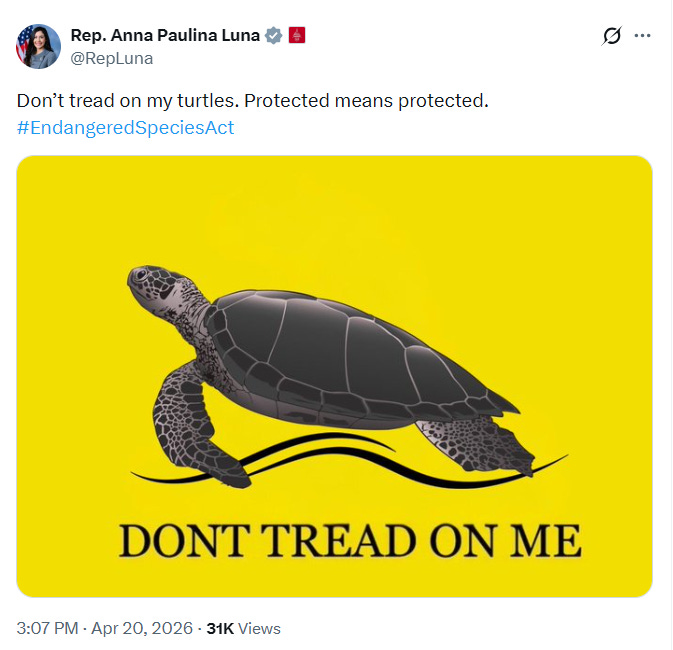
It was quite a turn of events for a House that, according to a Defenders of Wildlife tracker, has “proposed more than 60 pieces of legislation that would undermine the ESA or weaken protections for imperiled wildlife.”
Whether it is dead or it can be revived with changes that appease the Florida delegation remains to be seen. But there is some hope in Rep. Anna Paulina Luna’s stark tweet. She’s MAGA, but she also 36 years old … a Millennial who has grown up in an America that decided before she was born that it wasn’t going to tread on turtles.
When President Nixon signed the Endangered Species Act on December 28, 1973, it had passed the House by a vote of 355-4 and the Senate by a vote of 92-0. The ESA has been popular from the start. A 2025 study in Conservation Letters found that over the last twenty years support for the ESA “has remained consistently high, at about 84%, and opposition has remained consistently low, at about 12%.”
Despite that overwhelming support, the House came damn close to gutting the popular law. And it could still happen. If it does, we’ll have all the evidence we need to list representative government as the most endangered species of all. - jp
Support for the US Endangered Species Act Is High and Steady Over the Past Three Decades
https://conbio.onlinelibrary.wiley.com/doi/10.1111/conl.13111
More Americans Think U.S. Doing Too Little on Environment
https://news.gallup.com/poll/659390/americans-think-doing-little-environment.aspx