


THE SET-UP: Anthropogenic climate change made a rare appearance in America’s news cycle this week, but only because President Trump decided to pull out of dozens of international organizations and agreements … one being the United Nations Framework Convention on Climate Change (UNFCCC).
Established in 1992, the United States was the first industrialized nation to join the UNFCCC and, if you can believe it, the treaty was ratified by a vote of 92-0 in the Senate. Yeah, you read that right. In a Senate of 57 Democrats and 43 Republicans there wasn’t a single “no” vote. As for the non-votes, because the outcome was thought to be a fait accompli, the Senate opted for a “division” or “standing” vote that simply counts the number of “yeas” and “nays” without a formal roll call. Obviously, no one needed proof that they voted against a “hoax” or planned on campaigning on their opposition to a “Globalist conspiracy.”
Even former oil wildcatter George H.W. Bush supported the treaty. Amazingly enough, he signed the UNFCCC agreement on America’s behalf at the “Earth Summit” in Rio de Janeiro. That’s a Republican oil man going to a UN environmental shindig to sign the foundational international agreement on climate. Here’s an excerpt from Bush’s signing statement when he sent the treaty to the Senate for ratification:
I signed this convention on June 12, 1992, in Rio de Janeiro at the United Nations Conference on Environment and Development (UNCED). The convention was also signed by 153 other nations and the European Community. Today I am calling on them to join us in ratifying the convention as soon as possible and making a prompt start in its implementation.
The Climate Convention is the first step in crucial long-term international efforts to address climate change. The international community moved with unprecedented speed in negotiating this convention and thereby beginning the response to climate change.
As proposed by the United States, the convention is comprehensive in scope and action-oriented. All parties must inventory all sources and sinks of greenhouse gases and establish national climate change programs. Industrialized countries must go further, outlining in detail the programs and measures they will undertake to limit greenhouse emissions and adapt to climate change and quantifying expected results. Parties will meet on a regular basis to review and update those plans in the light of evolving scientific and economic information.
It’s stunning to think of how far the United States has descended into the '“demon-haunted world” Carl Sagan famously warned of just four years later in his book by the same name.
Now, in the 21st Century, President Trump has trashed the UNFCCC and twice pulled-out of the Paris Accord, which came directly from the treaty then-President Bush the Elder championed nearly thirty-four years ago. Trump did so in spite of mounting evidence that the planet is, indeed, getting warmer. Just two days after Trump trashed the treaty, “more than 50 scientists from 31 international institutions” published their findings on global ocean heat content (OHC), which rose for the ninth consecutive year. Take a look at the graph published by Inside Climate News:
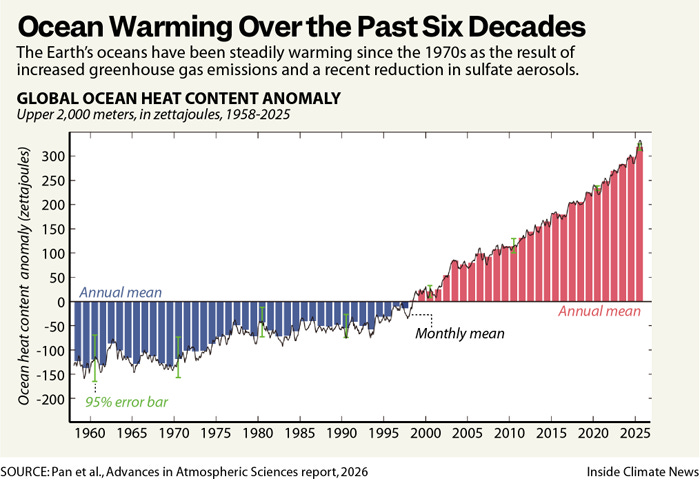
This heat—which Inside Climate News described rather ominously as the Earth’s oceans absorbing the “equivalent in energy to 12 Hiroshima-sized atomic bombs” every single second of the last year—is rapidly acidifying the world’s oceans. And that problem is compounded by a feedback loop. As a report published yesterday in The New York Times Magazine noted:
As carbon dioxide from the atmosphere dissolves into the ocean…it reacts with seawater to form carbonic acid, which disrupts the ocean’s chemical balance and reduces its capacity to absorb more carbon.
Because human beings have not made a meaningful effort to arrest our emissions, scientists are attempting to geoengineer a fix that not only mitigates the impact of our emissions. In the case of acidification, that means giving the oceans antacids. If only it was as easy as “plop-plop, fizz-fizz.” But even if scientists find a way to interrupt the feedback loop with a giant Alka Seltzer, it’s possible (and perhaps likely) it could produce unforeseen consequences.
It’s the wholly foreseen consequences of inaction that is now motivating scientists to not only mitigate acidification, but to try to reverse it. They want to coax the oceans into absorbing even more of the carbon we refuse to stop producing by changing our behavior:
Experts estimate that ocean alkalinity enhancement alone could remove somewhere between one and 15 billion tons. But the investment and infrastructure needed to reach even a fraction of that potential is immense. The supplemental mining effort required to remove just one billion tons of carbon dioxide annually by adding alkaline minerals to the sea would most likely be equivalent to a second global cement industry, for example.
Not coincidentally, cement, as Floodlight recently explained, has become “one of the planet’s biggest climate threats, generating about 8% of the world’s carbon dioxide emissions.” Also not coincidental is the fact that Trump has (of course) jettisoned plans to mitigate the cement industry’s emissions:
Moves to decarbonize the cement industry picked up speed during the administration of President Joe Biden, which channeled billions of dollars in Inflation Reduction Act (IRA) money toward reducing the carbon footprint of concrete and other construction materials.
The Trump administration has reversed course. In January, the Environmental Protection Agency canceled 21 grants aimed at reducing greenhouse gas emissions from concrete, cement and other construction materials, according to a spreadsheet compiled by The Sierra Club from EPA records.
So, even if ocean alkalinity enhancement “works,” the returns on that investment may ultimately be too marginal in a Trumped-up world to justify it. If nothing else, that underscores a phenomenon identified by German philosopher Günther Anders:
Anders introduced the idea of Promethean shame—the sense that humans feel inferior to their own machines. In the face of climate change, this shame appears in our growing faith in technological fixes. Carbon capture, geoengineering, and artificial intelligence are often presented as ways to solve the crisis without changing how we live. These proposals may have a role to play. But Anders would caution that they often express a deeper despair about human moral capacity. Rather than believing we can restrain ourselves, cooperate politically, or reimagine economic life, we place our hopes in machines to correct the damage caused by machines.
Perhaps that’s why Trump has been so effective in extirpating the issue of climate change from politics and the media. He’s built us an off-ramp to willful ignorance defiantly paved with climate altering cement. - jp
Bill Gates Says Climate Change Solutions, Children’s Health Lack Funding. AI Innovations Will Help.
https://www.barrons.com/articles/bill-gates-climate-change-solutions-children-health-funding-ai-e770e321
Oil companies want to keep the EPA Greenhouse Gas Reporting Program. Yes, really. | Opinion
https://www.houstonchronicle.com/opinion/outlook/article/epa-greenhouse-gas-oil-ai-support-21280285.php
Environmentalists push back against US EPA plan to extend coal plant closings
https://phys.org/news/2026-01-environmentalists-epa-coal.html
EPA Delays Coal Plant Wastewater Rule, Allowing Continued Toxic Discharges
https://eponline.com/articles/2026/01/05/epa-delays-coal-plant-wastewater-rule-allowing-continued-toxic-discharges.aspx
EPA to Delay Air Clean Up Plans for National Parks, Again
https://cleantechnica.com/2026/01/06/epa-to-delay-air-clean-up-plans-for-national-parks-again/
EPA Delays Enforcement Of Regional Haze Guidelines
https://www.nationalparkstraveler.org/2026/01/epa-delays-enforcement-regional-haze-guidelines
EPA ‘Revamping’ Clean School Bus Program
https://stnonline.com/news/epa-revamping-clean-school-bus-program/
EPA plans more environmental deregulation in 2026
https://cen.acs.org/environment/epa-deregulation-zeldin-climate-endangerment-vehicle-emission-rules/104/web/2026/01