


THE SET-UP: We’ve got quotes…
Here’s Trump from his first evening back in the White House:
"I looked at a picture of Gaza, it's like a massive demolition site. It's really … it's gotta be rebuilt in a different way. Gaza's interesting, it's a phenomenal location. On the sea, the best weather. Everything's good. Some beautiful things can be done with it. It's very interesting. Some fantastic things can be done with it." – President Donald J. Trump, speaking extemporaneously with reporters during an executive order signing session in the Oval Office
Here’s Jared holding forth about a year ago:
“Gaza’s waterfront property, it could be very valuable, if people would focus on building up livelihoods. It’s a little bit of an unfortunate situation there, but I think from Israel’s perspective, I would do my best to move the people out and then clean it up. But I don’t think that Israel has stated that they don’t want the people to move back there afterwards.” – Jared Kushner in in a Februrary 15, 2024 interview recorded at Harvard University’s Kennedy School of Government Middle East Initiative
And here’s Indonesia’s response to a trial balloon Trump’s Middle East Envoy seems to have floated through an underling:
According to the New York-based news outlet NBC News, US President-Elect Donald Trump’s team is mulling putting forward a proposal to temporarily relocate some of Gaza's two million residents during the post-war reconstruction efforts. Trump’s envoy to the Middle East, Steve Witkoff, revealed that Indonesia was among the possible host countries. Indonesia -- which has been vocal about its Palestinian support -- immediately issued a comment, saying that the government had never heard of such a plan.
So, what’s the point?
There’s no doubt Biden’s handling of Gaza was disastrous for Gazans (and for Kamala Harris).
That stipulated, I think it can also be argued that Netanyahu neutered him when he spoke to a joint session of Congress. It may have been the most audacious move ever made by a US “ally.” He demonstrated his ability to "trump” (pun intended) his benefactor by going around him to both Congress and the American people. With those standing ovations, and the media frenzy it generated, Bibi basically cut Biden off at the knees. Biden was trapped between Bibi’s loud demonstration of political clout and the growing political liability of Anti-Semitism.
That allowed Trump to have it both ways … appealing to the Administration’s critics on both sides of the issue. He featured Anti-Semitism in a very effective “Deli Talk” ad. He also took advantage of Arab-American despair as Biden’s bombs killed kids and relatives.
That was then and this is now. And now I’d be willing to bet on buyer’s remorse in Dearborn … and sooner rather than later. Because I also suspect a deal was cut between Bibi and Trump … one that dangled the ceasefire like a carrot until the very end of Biden’s Presidency. That gave Bibi plenty of time to drop more bombs and it gave Trump a chance to take credit for the ceasefire. Now Bibi can get the hostages out. Eventually, as Trump himself predicted, the ceasefire can be broken and Bibi can get back to making Gaza completely unlivable. In the meantime, the redirected IDF can get busy in the West Bank and Trump can rubber-stamp the settler movement Bibi needs to keep his government afloat. No, I don’t have proof of this deal. But it’s still early. - jp
TITLE: Trump revokes sanctions on Israeli settlers in West Bank: What we know
https://www.al-monitor.com/originals/2025/01/trump-revokes-sanctions-israeli-settlers-west-bank-what-we-know
EXCERPTS: Trump reversed a slew of Biden's policies in an executive order called "Initial Rescissions of Harmful Executive Orders and Actions." Those included sanctions imposed by Biden on Israeli settlers.
Biden signed Executive Order 14115, “Imposing Certain Sanctions on Persons Undermining Peace, Security, and Stability in the West Bank," on Feb. 1, 2024.
It imposed sanctions on 17 Israeli individuals and 16 entities, while stopping short of sanctioning senior Israeli officials supporting the settlement expansion.
Trump revoking this policy was a key wish of far-right Israeli groups that believed Trump's victory would mean backing for further Israeli settlements in the West Bank and perhaps US backing for an Israeli annexation of the territory.
Finance Minister Bezalel Smotrich thanked Trump in a post to X on Tuesday. “Mr. President, your unwavering and uncompromising support for the State of Israel is a testament to your deep connection to the Jewish people and our historical right to our land,” he wrote.
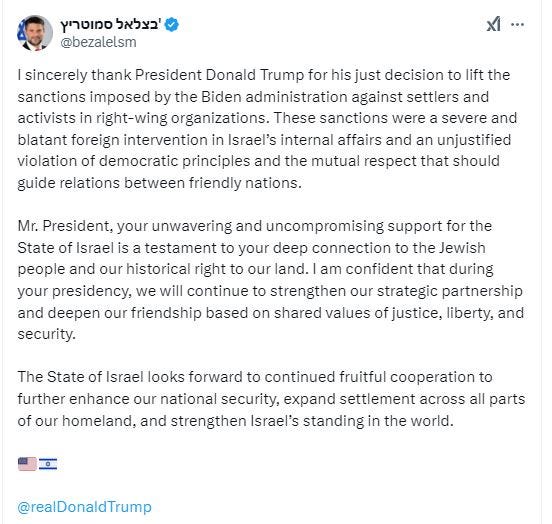
Now-resigned National Security Minister Itamar Ben-Gvir reacted similarly, calling Trump's decision "a righting of an injustice of many years, in which distorted policies were pursued by the American administration," in a post to X Tuesday.
In late February, following the sanctions, Biden restored a US legal finding calling the settlements “illegitimate” under international law.
Earlier this month, a report from the United Nations Office for the Coordination of Humanitarian Affairs recorded roughly 1,420 incidents of settler violence in the West Bank since the beginning of 2024. The incidents led to the deaths of five Palestinians and injury of 360 others.
TITLE: Israeli Settlers Burned West Bank Homes in Riots Organized on Chat Groups
https://www.wsj.com/world/middle-east/israeli-settlers-organized-west-bank-riots-on-chat-groups-d2cceb07
EXCERPTS: As Palestinian families prepared to welcome relatives freed from prisons Sunday in a cease-fire deal between Israel and Hamas, Israeli settlers in the occupied West Bank sent out a call to action: stop them from going home.
What followed was two nights of armed attacks on Palestinian villages that destroyed homes and cars and left dozens injured, according to the Israeli military and the Palestinian Ministry of Health.
The violence reflects the anger over the cease-fire deal among people on Israel’s extreme right wing, many of whom are West Bank settlers opposed to ending the war and releasing Palestinian prisoners, and determined to build Jewish settlements in Gaza.
Pressure on Israel to curb settler violence is expected to lessen under President Trump. After taking office Monday, Trump signed an executive order discarding sanctions on violent settlers imposed by the Biden administration. Several settler leaders were at Trump’s inauguration.
On Monday night, Palestinian villages came under renewed attack by settlers, and the Israeli army said it was called to the area to disperse riots. Major roads in the West Bank were closed by the Israeli military, according to Wafa, the Palestinian Authority’s information agency.
The attacks, which began after the implementation of the cease-fire deal, appear to have been provoked by calls on messaging platforms for Jewish settlers to protest the release of Palestinian prisoners under the agreement.
Around midnight on Sunday, hours before the cease-fire took effect, far-right Israelis went on WhatsApp and other messaging platforms urging people to protest in Palestinian villages.
The messages spread as thousands of people joined newly created WhatsApp groups that promised to provide information on the release of prisoners, who they called “dangerous terrorists.”
The detainees released were women and teenagers, many of whom were held by Israel under its administrative detention system, according to Arab mediators. The system allows Israel to hold detainees without charge or trial for years on end, on national security grounds.
“Unfortunately many serious terrorists with blood on their hands are being released to Jerusalem and Judea and Samaria,” read the description of one of the main groups sharing updates on protests, using the biblical name for the West Bank.
The group promised to update members about where the prisoners would be released and later sent out calls to protest and block the entrances to the parts of the West Bank where they live. They also sought to bar the detainees from leaving prison compounds.
“There is only one way to talk to terrorists—only force,” a participant in one WhatsApp group wrote on Sunday, according to the message seen by The Wall Street Journal.
A spokesperson for Meta Platforms, WhatsApp’s parent company, said “organizing or coordinating violence breaks our rules and we will respond to any valid legal requests.”
As part of a U.S.- and Arab-brokered cease-fire deal, three Israeli female hostages were released from Gaza on Sunday in exchange for 90 Palestinian prisoners.
By around 7:30 p.m., as word spread that Palestinians were leaving jails, dozens of attackers descended on several villages along a major roadway near the West Bank city of Nablus, many armed with rifles and Molotov cocktails, according to a witness and Israeli nongovernmental organizations.
Ayed Jafry, a 45-year-old West Bank resident, said his village came under attack on Sunday night. He shared video footage he said was taken from the scene in Sinjil, showing cars ablaze and homes damaged and burned. Attackers threw rocks at Palestinians who stood in their way and threatened to harm those who blocked them or tried to help the injured, Jafry said.
Settlers had circulated word on WhatsApp that one of the released Palestinian prisoners would be heading to Sinjil, according to a screenshot of the message reviewed by the Journal.
“It was terrifying,” said Jafry, who was among villagers who rushed to help victims as the violence was unfolding. “I am afraid it will get a lot worse. Settler attacks have been commonplace here, but I think they will begin to target more villages because they are upset with this deal.”
Settler violence has been on the rise since Israeli Prime Minister Benjamin Netanyahu established the most right-wing, religious and ultranationalist coalition in Israeli history in 2022. Settler leaders who took up positions as ministers have held an outsize sway in the governing coalition, making it politically risky to crack down on violence perpetrated by settler groups.
The scale and frequency of settler attacks against Palestinians have grown as the use of social-media platforms has enabled messages inciting violence, said Achiya Schatz, founder and executive director of FakeReporter.
“What’s amazing about this is that it takes place in WhatsApp groups pretty openly, people using their names, including some people who are known,” Schatz said. “It really has become a recurring pattern of activity.”
FakeReporter said it is seeing preparations for the next batch of releases set to take place this weekend.
The United Nations Office for Humanitarian Affairs said 1,700 Palestinians were displaced and hundreds injured in 1,400 incidents of settler violence last year.
Only a fraction of settler violence against Palestinians results in convictions. Israeli soldiers, some of whom are themselves settlers, sometimes take part in the attacks, according to several Israeli, Palestinian and international human-rights organizations.
TITLE: Jared Kushner May Profit From Expanded Israeli Settlements
https://jacobin.com/2025/01/kushner-cease-fire-israel-settlements
EXCERPTS: On Wednesday, hours before the cease-fire deal was formally announced, Israeli regulators approved a deal that gave Kushner nearly 10 percent ownership in Phoenix Financial Ltd, a major Israeli finance and insurance firm, making him the company’s largest shareholder.
Affinity Partners, Kushner’s private equity firm that is backed by a $2 billion investment from Saudi Arabia’s sovereign wealth fund and the source of several Senate investigations, first invested in Phoenix Financial back in July, acquiring a 4.95 percent stake in the company. At the time, Affinity proposed to double that share if regulators gave the green light. This week, they did.
Phoenix Financial, one of Israel’s largest financial and insurance firms, has financed and insured construction projects throughout Israeli settlements in the West Bank and the Syrian Golan Heights. Phoenix owns an 80 percent stake in a large shopping mall in an East Jerusalem settlement and stakes in various companies operating throughout other settlements, according to Who Profits, a research center that investigates companies profiting from Israeli occupation.
Phoenix Financial, previously known as Phoenix Holdings, has helped finance wind and solar projects in Israeli settlements and provided financial services to the local councils of settlements, including the Beitar Illit and Oranit settlements in the West Bank.
The Israeli government approved a plan in December to expand settlements in the Golan Heights by investing more than $11 million to “encourage demographic growth” in the region, Prime Minister Benjamin Netanyahu said. The new expansion plan was announced a week after Syrian President Bashar al-Assad fled the country as rebels seized control of the capital.
The company’s investments are emblematic of the profits that many firms see in the expansion of Israeli settlements. Banks partner with developers to build homes on land unlawfully seized from Palestinians, turning the seizures into big returns. Other companies profit from agricultural lands and water sources.
Kushner has spoken openly about the potential of such investments. At an event at Harvard University last March, as war raged in Gaza, Kushner observed that “Gaza’s waterfront property could be very valuable.”
“It’s a little bit of an unfortunate situation there, but from Israel’s perspective, I would do my best to move the people out and then clean it up,” he added.
Israeli settlers — and the financial firms invested in the settlements — are likely to see strengthened US support under a second Trump administration.
In Trump’s first term, illegal settlements in the West Bank expanded massively as the president threw his support beyond Israel’s territorial claims. After Trump’s victory in November, Israeli settlers in the West Bank celebrated, hoping that a second Trump administration would mean securing additional control over the occupied territory as well as expanding settlements into Gaza.
Settlers will also have an ally in Kushner, who is likely to be influential on Middle East policy in a second Trump administration, even though he’s not set to have an official role in the administration.
As cease-fire negotiations have progressed, Kushner has been reportedly advising Trump officials behind the scenes. Although the Biden administration and leading Democrats said for months that they had been working “tirelessly” on a cease-fire, negotiations saw a breakthrough this week, reportedly due to the involvement of the incoming Trump administration.
During the first Trump administration, Kushner served as a senior adviser to the president and oversaw certain policy decisions in the Middle East. Six months after he left his role in the White House, Kushner received a $2 billion investment in his private equity firm from the Saudi wealth fund that is led by Crown Prince Mohammed bin Salman.
SEE ALSO:
In Israeli-annexed Golan's 'Trump Heights', settlers ready for expansion
https://www.rfi.fr/en/middle-east/20241218-in-israeli-annexed-golan-s-trump-heights-settlers-ready-for-expansion
Revealed: Settlers plan major Trump-era transformation for West Bank
https://www.israelhayom.com/2024/12/01/revealed-major-transformation-in-judea-and-samaria-planned-by-settler-leaders/
West Bank Annexation: Will Israel finally do the deed?
https://mondoweiss.net/2024/11/west-bank-annexation-will-israel-finally-do-the-deed/