


U.S. to set limits on silica exposure first recommended half a century ago
https://www.statnews.com/2024/04/16/silica-new-rules-msha-mine-safety-silicosis/
EXCERPT: Crystalline silica is one of the most common minerals on earth. It can be found in sand, stone, and soil, and its dust is common in coal and other types of mining. It is also a carcinogen, and overexposure can cause severe lung issues, in particular silicosis, a condition in which small silica particles scar the lungs and reduce their ability to take in oxygen. This is a chronic, often debilitating condition that can be fatal, and it occurs after exposure to high concentrations of silica crystals, with symptoms emerging up to a decade later. Silica exposure can also increase the risk of tuberculosis, lead to lung cancer, and is linked to black lung disease, a deadly condition that can make breathing difficult and which has affected thousands of miners in the past decade in Virginia and Kentucky.
“It is unconscionable that our nation’s miners have worked without adequate protection from silica dust despite it being a known health hazard for decades,” said Julie Su, the labor department’s acting secretary, in a statement announcing the rules.
The regulations also require periodic free health examinations for miners and state that mine operators are in charge of monitoring silica exposure and preventing overexposure. “These kinds of regulations are low-hanging fruits to save lives. I think that the fact that we’re actually moving forward with them is great, but this should have been taken care of decades ago,” said Bobby Mahajan, a pulmonologist and spokesperson for the American Lung Association.
He added that there needs to be more stringent use of masks and protective equipment to limit silica’s effects, not just in mines but also in construction sites and wherever people are engaged in stone cutting.
Mahajan said it’s often the workers who avoid using masks or respirators, which indicates a lack of awareness about the seriousness of silica exposure. “It is really important to educate workers, but also educating the companies that utilize these workers to protect them appropriately,” he said.
Mining organizations have welcomed at least part of the rule. “We are still reviewing the rule and need to discuss it with our members, but we fully support the new, lower limits contained in the rule,” said Conor Bernstein, a spokesperson for the National Mining Association, in an email to STAT. However, the organization thinks there are important elements still missing in the rule, in particular when it comes to enforcement and the adoption of protective equipment. “Our recommendations on the draft rule included allowing for the use of administrative controls and personal protective equipment (PPE) to supplement and enhance engineering controls; unfortunately, those recommendations were not included in the final rule,” said Bernstein.
TITLE: New EPA rule to reduce industrial air pollutants leaves out a majority-Black West Virginia community
https://mountainstatespotlight.org/2024/04/14/epa-air-pollutant-rule-institute/
EXCERPT: Last week, Biden administration officials finalized a rule they said would significantly reduce cancer-causing air pollutants, lowering cancer risk and advancing environmental justice goals. But the move by the U.S. Environmental Protection Agency left out a Black West Virginia community yet again.
While the rule will target facilities surrounding communities historically overburdened by toxic air pollution, it doesn’t cover the chemical production category that has disproportionately affected one of West Virginia’s only two majority-Black communities.
“It’s actually a positive development, but it doesn’t fully address the issues in Institute,” said Maya Nye, a former Kanawha Valley resident and member of the Charleston-based People Concerned About Chemical Safety.
A 2021 Mountain State Spotlight and ProPublica story detailed how majority-Black communities across the country, like Institute in West Virginia, were saddled with a disproportionate health burden from industrial pollution. A ProPublica analysis found that Institute faces an increased cancer risk from industrial air pollution at 36 times the level the EPA considers acceptable.
In September, the Charleston-based group sued the EPA to force the agency to update federal emissions standards for facilities that produce polyether polyols — a chemical production category that emits ethylene oxide.
Elevated cancer risks also affect the overburdened “Cancer Alley” along the Mississippi River between Baton Rouge, Louisiana, and New Orleans as well as around Houston, Texas, where there are also clusters of polyether polyols production facilities, according to the lawsuit.
The West Virginia organization, along with the Louisiana Environmental Action Network and the Sierra Club, filed the lawsuit against the EPA for failing to perform its required duties by missing a 2022 deadline to update the polyether polyols production source category, which applies to the Union Carbide facility, now owned by Dow Chemical.
Dow Chemical did not respond to an emailed request for comment. The company has told other media outlets its emissions are safe, but it is committed to reducing them further.
The EPA’s new rule strengthens standards for chemical plants that make synthetic organic chemicals, polymers and resins, which federal regulators say will “dramatically” reduce the air toxics-related cancer risks for communities who live near roughly 200 plants. The EPA estimates that ethylene oxide and chloroprene emissions from synthetic chemical plants will be reduced by 80%.
“We promised to listen to folks that are suffering from pollution and act to protect them. Today we deliver on that promise with strong final standards to slash pollution, reduce cancer risk, and ensure cleaner air for nearby communities,” EPA Administrator Michael S. Regan said in a press release.
Four plants in West Virginia will be subjected to the stricter rules, including the Altivia site in Institute and the formerly DuPont chemical plant, now owned by Chemours, in Belle, according to the EPA.
Under the rule, chemical plants that make, use or store the key air pollutants, including ethylene oxide, chloroprene and benzene, will be required to monitor emissions at their fenceline. The data collected will be posted quarterly by the EPA and will help ensure facilities control their air pollutants.
Although the rule doesn’t address the outdated standards for the polyether polyols source category identified in the lawsuit against the EPA, it is still highly relevant, according to Adam Kron, an attorney for Earthjustice representing the environmental groups.
TITLE: Rep. Clay Higgins Wants EPA Chief Imprisoned For Regulating Pollution While Black
https://www.wonkette.com/p/rep-clay-higgins-wants-epa-chief
EXCERPT: During an April 5 speech in Philadelphia previewing the new regulations, [EPA Administrator Michael] Regan said, “I’m excited to say that in the coming weeks, we’re going to announce a really strong regulation addressing those chemical plants in Cancer Alley," using the nickname for an infamous 85-mile industrial corridor between New Orleans and Baton Rouge where cancer cases are far higher than in the rest of the nation. Fifty-one of the 200 plants that will need to clean up are located in Louisiana, and about that many are in Texas, next door.
A normal politician might celebrate the EPA’s estimate that the new regulations will reduce elevated cancer risk by 96 percent for people living near chemical plants that emit dozens of carcinogenic chemicals, particularly ethylene oxide and chloroprene. Instead, Rep. Clay Higgins (R-Louisiana) wanted to send Regan away to Louisiana’s maximum security prison, Angola.
Gee, we wonder what part of this screenshot of the Times-Picayune story set Higgins off so badly?
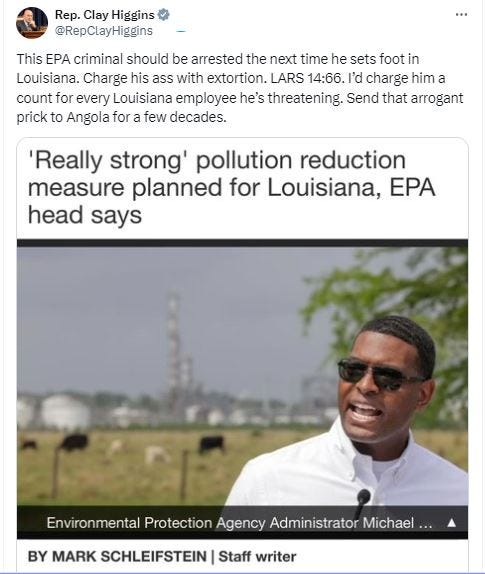
Could it have been the headline, “'Really strong' pollution reduction measure planned for Louisiana, EPA head says”? Or maybe the fact that an announcement that will affect Louisiana was made in the Yankee enclave of Philadelphia? Or possibly the fact that the photo, from 2023, shows Regan, who is Black, speaking in front of one of the state’s worst chemical plants as if he had any kind of authority?
Wow, Higgins was steamed! He tweeted,
“This EPA criminal should be arrested the next time he sets foot in Louisiana. Charge his ass with extortion. LARS 14:66. I’d charge him a count for every Louisiana employee he’s threatening. Send that arrogant prick to Angola for a few decades.”
Rep. Higgins, a cancer ally who has been in Congress since 2017, has apparently not yet been briefed on the EPA’s authority to regulate harmful pollutants under the Clean Air Act. Worse, he appears not to know that even Black men are allowed to serve as agency heads these days, even if he thinks they look “arrogant” in a photo.
To be sure, the new regulations will have an economic impact in addition to causing less cancer, and that’s the other reason Higgins is so mad. Sure, there may be fewer cases of cancer among the poor Black people living in Cancer Alley, but what about all the money that chemical companies will have to spend to bring their operations into compliance? Are a few tens of thousands of unimportant people’s lives and health really worth the disruption?
As NPR reports, the regulations will be especially terrible for one good decent job-creating polluter, Denka Performance Elastomer in St. John the Baptist Parish, right in the middle of Cancer Alley. The company is America’s sole producer of chloroprene pollution, from its production of neoprene, “a synthetic rubber used in things like beer koozies and wetsuits.”
Won’t someone think of the beer koozies and wetsuits?
Chloroprene exposure levels near the plant are some 400 times the amount the new rules allow. A 2016 report determined that the Denka plant’s emissions contributed to the highest cancer risk anywhere in the USA.
In addition to the new rule, the EPA and Justice Department sued Denka last year, alleging its emissions present “an imminent and substantial endangerment” to people in surrounding communities. That suit has not yet gone to trial, and we can’t determine whether Rep. Higgins called for any of the prosecutors to be sent to break rocks on a chain gang.
NPR notes that the Denka plant is right next to an elementary school whose students are predominantly Black, some of whom may even be arrogant.
"Rep. Clay Higgins Wants EPA Chief Imprisoned For Regulating Pollution While Black" reports such BLATANT racism. Based on what America was programmed to be, in our founding documents, which are its (broken, very hackable) operating system, Clay Higgins is a FOREIGN ENEMY of America. He's no more American than a maggot eating dog shit in North Korea.
And for this, Rep. Higgins gets NO pushback, and if anything, this kind of talk burnishes his career. We have so far to go if we are ever going to even come close to rebooting our OS. Our whole system has seized up because of human viruses like Higgins. If we were actually America, his speech would be considered an act of treason or a sign of severe mental illness.