


It’s not surprising that young Americans are increasingly disillusioned with capitalism.
The first Millennials were born during the first year of Ronald Reagan’s first term in office. That was also the year the American economy was set on its current trajectory. And that means everyone who followed those first Millennials did not experience the heyday of demand side economics in the 1950s and 60s, or feel its lingering impact in the oil shocked 1970s. They’ve never known an America of robust unions, robust manufacturing and robust public investment, let alone a nation of defined benefit pension plans or a 70% tax rate on the highest income earners. They also don’t know an America of single-income households, healthy public schools and a growing middle class. And they certainly didn’t grow up in an America where access to its “Dream” could be had with a high school diploma. They have no idea what it’s like to walk out of high school into a thriving economy that actually makes things.
Instead, they were born into an America of dual-income households, lagging wages and a bifurcating middle class. They were told early on that a high school education is not enough. They had to get a college diploma, preferably in STEM, if they wanted a shot at the Dream. Many did just that. But the cost of a college education ballooned and millions of students had to finance their diploma with billions in debt that will weigh them down for years, if not decades.
They carried that debt into an economy designed to concentrate wealth, assets and capital into the hands of a small cadre of financial elites. That’s the supply side economic “revolution” Reagan started in 1981. It’s an economy driven by the speculative bets of investors and financiers rather than the purchasing power of wage earners. It’s an economy that makes deals and exotic financial instruments instead of things. It’s an economy of mergers and acquisitions and hostile takeovers and asset stripping. It’s an economy fueled by debt, which is often packaged and sold as a commodity. It’s also an economy destined to generate speculative bubbles. And now, after a series of wealth-concentrating booms and busts, it’s an economy that’s sorting what’s left of middle class into a K-shaped society of haves and have-nots.
It is the ultimate triumph of supply side capitalism.
Former Fed Chair Alan Greenspan lived long enough to see the apotheosis of the neoliberal project he managed for nearly nineteen years. By the time he died in June, the tech-boosted supply side of the economy had grown so flush with capital, assets and wealth that the top 10% became functionally immune to the inflationary pressures currently punishing wage earners sliding down the lower arm of the K-shaped economy.
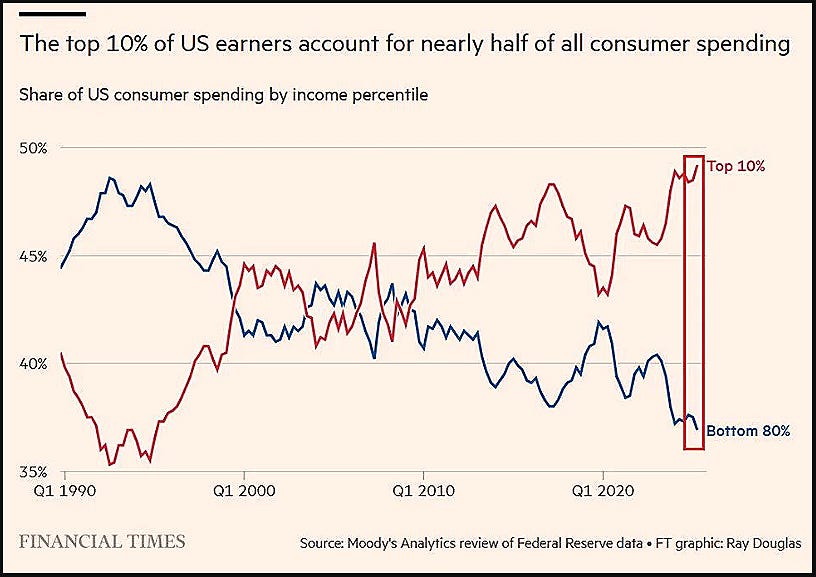
The oldest Millennials began coming of age when the top 10% first leapfrogged the bottom 80% in 2000. Many more did before, during and immediately after the final flip in 2009. It’s no coincidence that the first flip occurred during the Dotcom Crash and the second during the aftermath of the Crash of 2008. Each time, the liquidity-fueled supply side feasted on bargains, while wage earners lost their purchasing power, their 401ks (Dotcom) and their tenuous hold on the American Dream (Crash of 2008). It’s not a bug, but instead a feature of the economy Greenspan shepherded from Black Monday in 1987 to the eve of the subprime crash in 2006.
The K-Shape of Things to Come
When he retired as Chair of the Federal Reserve in 2006, Greenspan was widely revered as “the Maestro” for his handling of monetary policy during the booming Clinton years. Nominated by four Presidents, the one-time devotee of Ayn Rand served five consecutive terms and enjoyed bipartisan support throughout the time he served as Chair of the Federal Reserve.
But his reputation truly soared throughout the 90s.
When he spoke, markets hung on his every word.
E.F. Hutton listened to him.
In 2002, a pair of economists trumpeted his tenure as “The Great Moderation,” which the Federal Reserve’s official history describes as a “welcome period of relative calm after the volatility of the late 1970s.” The Greenspan era’s unique combination of strong growth, low unemployment and subdued inflation was also called “the Goldilocks Scenario.” Of course, the Fed is convinced that “better monetary policy was key” to getting the porridge “just right.”
“Unfortunately,” the official history continues, ”the financial crisis of 2007-08 and the ensuing Great Recession broke the calm of the Great Moderation.”
“Broke the calm”?
That’s quite an understatement of what was broken by the Crash of 2008.
Similarly, the supposed “period of relative calm” that preceded the Crash was anything but. Black Monday (1987), the Savings and Loan Crisis (1986-1995) and the Dotcom Bubble (2000) not only preceded the Crash of 2008, but they are emblematic of a Greenspan-stoked boom-and-bust cycle that has progressively concentrated assets and capital into the hands of investors and financiers on the supply side of the economy.
The Fed’s official history characterizes the Crash as “unfortunate,” as if it was an act of god or an unforeseen “black swan”. It was not. Instead, it was Greenspan’s willingness—perhaps even his eagerness—to use monetary policy to mitigate the excesses and shortcomings of supply side economic policies that fostered the highly financialized system many now refer to as the Casino Economy.
Aptly dubbed “the Apostle Of Easy Money” by the Policy Circle Bureau, Greenspan’s quasi-religious devotion to re-supplying the supply side after it crashed only emboldened the market’s rampant speculation. He invited the market’s transformation into a casino by eliminating a key component of a properly functioning market—punishment. The “free market” is supposed to punish wild speculation, bad investments and malfeasance. But it didn’t under Greenspan. He handcuffed the Invisible Hand of the free market when it came time for the Hand to punish bad decisions. When the market teetered, Greenspan intervened.
It was a die Greenspan cast just months into his first term atop the Fed when he responded to the Black Monday market crash in 1987 with a flood of liquidity. It quickly “stabilized” the market by putting easy money on the menu and, as the Policy Circle Bureau explained after his death, Wall Street was hooked:
They learned that the Fed would move quickly when asset prices fell. The lesson was reinforced in 1998, when the New York Fed helped organise a private rescue of Long-Term Capital Management, and again after the dotcom bust. The phrase “Greenspan put” was crude, but it captured a real change in market behaviour. Losses would be socialised through lower rates and liquidity support. Gains would remain private.
The “Greenspan Put” lessened or, some might argue, completely removed the incentive to avoid excessive risk. Investors need not worry about crashing a market sector or the entire market if the Fed was sure to bail them out.
And it did under Greenspan. Repeatedly.
But it wasn’t just bailouts.
In 1992, Greenspan responded to short-lived recession by dropping the Fed’s rate down to 3% in September. Although it came too late to reverse George Bush the Elder’s electoral fortunes, it was a propitious time to lavish investors with cheap and easy money. Less than two months later, Bush lost to a self-styled New Democrat who would embrace the Reagan’s supply side agenda and, therefore, sever his party’s long association with demand side economics.
Monkey See, Monkey Do
Walter Mondale’s epic 49-state drubbing in the 1984 Presidential Election effectively rubberstamped Reagan’s supply side agenda of tax cuts, deregulation and cuts to public assistance programs. Reagan ran on a sharp economic turnaround stoked by a combination of tax cuts passed in 1981 and the anti-inflationary hawkishness of then-Fed Chair Paul Volcker’s elevated interest rates, which still sat at an effective rate of 9.43% just days before the 1984 election. Economic growth spiked to 7.6% and voters delivered a second consecutive landslide to the Republicans.
That, in turn, convinced a group of “moderate” Southern Democrats their party was losing touch with a changing electorate. They couldn’t beat them, so they decided to join them. That meant embracing Wall Street, corporate America and “market-based solutions,” which they did. Then-Arkansas Governor Bill Clinton was a founding member of their organization—the Democratic Leadership Council. It was a natural fit. After all, the Clintons were well-practiced in the art of wooing big business thanks to their close relationship with Arkansas-based Walmart. Hillary served them as a corporate lawyer and even sat on Walmart’s board of directors while Bill served as governor.
When Massachusetts Governor Michael Dukakis suffered the party’s third consecutive landslide loss in 1988, the DLC was poised to prove its concept. And it did so four years later when Bill Clinton weathered a rocky primary in New Hampshire and went on to win the White House. Clinton broke his party’s losing streak by focusing on dissatisfaction with the recession-addled economy, but it was Alan Greenspan who became the biggest winner when the self-described “New Democrat” populated his economic team with willing partners like Larry Summers and Robert Rubin.
Working together, Greenspan’s Fed and Clinton’s economic team continued the supply side agenda, albeit under different names. “Reaganomics” was repackaged and sold as “Rubinomics,” and the politically-loaded term “supply side economics” was rebranded as “neoliberalism.” It marked the functional end of the Democrats’ demand side orthodoxy, which dated back to the New Deal. As Clinton famously said in his 1996 State of the Union address, “the era of big government is over.” In it’s place he established a post-Cold War “neoliberal consensus” with Tony Blair’s “New Labor” in the UK. And it all began in earnest with the Clinton Administration’s defense of global free trade.
The Giant Sucking Sound
President Clinton and Vice President Al Gore championed NAFTA and, despite running against Bush the Elder for cozying up to “the Butchers of Beijing” in the wake of Tiananmen Square, Clinton quickly flipped his position and rubberstamped Most Favored Nation (MFN) trade status for China. That, along with the passing of NAFTA in November of 1993, opened the floodgates. Manufacturing flowed to cheaper labor overseas, with Clinton-connected Walmart leading the way into an evermore globalized labor market.
But that’s not all.
Wall Street began tapping into capital from wage earners. The shift from defined benefit pension plans to 401ks in the 1980s meant that wage earners were increasingly invested in the market on the eve of one the great bull runs in economic history. Many of them paid attention to the stock market for the first time. They pored over quarterly statements and switched mutual funds in the hopes of higher returns. And they were joined by the burgeoning internet’s new class of speculator—the day trader.
Wall Street reveled in the new influx of capital.
By the time Vice President Gore gave the keynote address at a Superhighway Summit at UCLA on January 11, 1994, the economy was primed for what quickly became the Dotcom Bubble. In response, Greenspan racheted-up the Fed rate from a low of 3% to 5.75% over the course of 34 months, but nothing seemed to contain what he famously referred to as the market’s “irrational exuberance” in 1996. He often warned of a concomitant rise in inflation—both of assets and wages.
But a funny thing happened on the way to the Dotcom collapse.
Secret Sauce
In the year after Greenspan warned of irrationally-stoked inflation, the US inflation rate dropped from 3.32% in 1996 to 1.70% in 1997! It was an “a-ha!” moment for Greenspan. Veteran business reporter Louis Uchitelle explained it in a February 27, 1997 story for The New York Times:
For months now, the Federal Reserve has been poised to raise interest rates, but has held off. Why?
The answer lies mainly in what the Fed’s chairman, Alan Greenspan, describes as a powerful recent force in the American economy: job insecurity. In his testimony to Congress yesterday, he clearly elevated this insecurity to major status in central bank policy. Workers have been too worried about keeping their jobs to push for higher wages, he said, and this has been sufficient to hold down inflation without the added restraint of higher interest rates.
If you watched Greenspan’s congressional appearances at the time, you may recall his obsession with inflation. Aside from his momentary concern about the price of financial assets, his primary bugbear was the price of labor—a.k.a. wage inflation—which should’ve risen along with the burgeoning Dotcom bubble. This is how Greenspan described it in a speech delivered at the Federal Reserve Bank of Chicago just eleven months before the bubble burst:
Lower inflation in recent years has altered expectations. Workers no longer believe that large gains in nominal wages are needed to reap respectable increases in real wages. Moreover, incongruously, at the same time that labor markets tightened, workers' fear of job skill obsolescence rose, apparently, as a consequence of the rapid changes in technology that have induced the accelerated churning in the nations' capital stock with which our workforce must interact day by day. Job security has seemingly become more relevant than wage gains as a result. The return of experienced workers for further schooling is remarkable and attests to the surprising depth of worker job insecurity in the face of ever tightening labor markets.
More job insecurity equals low wage inflation … that’s the secret sauce of Greenspan’s tenure. Insecure labor is pliable and less likely to demand an increase in wages, let alone the health and retirement benefits that workers enjoyed during the post-World War II economy. With wage inflation contained by diminishing demands of uncertain and fearful workers, Greenspan realized he could keep the Fed’s rate low without added inflationary pressure.
Frankly, Greenspan was right. The fact that experienced workers were scrambling back to school, perhaps to acquire computer skills, does hint at the depth of insecurity bubbling below the surface of a “booming” economy. But the job insecurity created by new technology was not nearly as daunting as the offshoring, outsourcing and de-industrialization that picked-up steam over the eight years Clinton was in a neoliberal ménage à trois with Rubin and Greenspan. And guess who got screwed?
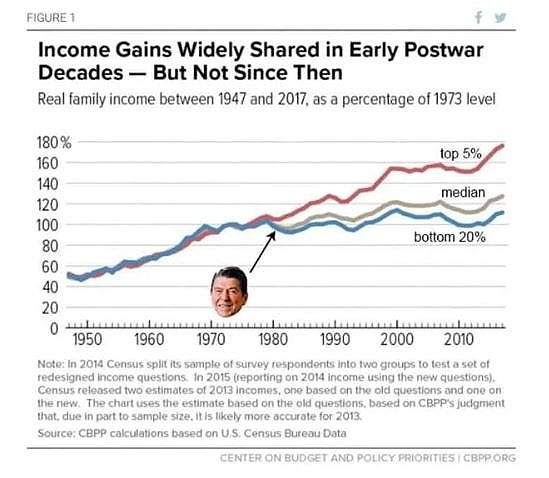
As good as the Clinton economy may still feel in retrospect, that’s the decade when Reagan’s neoliberal, “supply side” revolution was nearly completed. Clinton embraced welfare reform and he eventually pushed for and signed the U.S.–China Relations Act of 2000, which upgraded China to Permanent Normal Trade Relations status. His administration deregulated telecommunications and Treasury Secretary Rubin’s Wall Street-friendly approach to oversight and deregulation of financial markets accelerated economic financialization. Consumer credit conveniently expanded to fill the gap between stagnant wages and the cost of the American Dream. And because job insecurity dampened their wages, Greenspan was free to give investors and financiers plenty of cheap financial fuel as they passed wage earners on the Information Superhighway.
“POP!” Goes The Economy
When the Dotcom Bubble finally burst in March of 2000, Americans watched their retirement dreams evaporate as their 401ks crashed and Silicon Valley became a graveyard of failed ventures. The bursting bubble only heightened workers’ sense of insecurity, thus paving the way for yet more easy money and, predictably, the next bubble.
Back in 2008, Cato Senior Fellow Gerald P. O’Driscoll Jr. looked back at Greenspan’s tenure in light of the popping Housing Bubble:
As Fed chairman, Greenspan was the architect -- the “maestro” -- of a low-interest policy that flooded the economy with cheap credit after the collapse of the dot-com bubble in 2000-01. Real (inflation-adjusted) short-term interest rates were negative for several years. Risk premiums were driven down to historic lows, indeed they all but disappeared. These were the elements making for a classic asset bubble.
Greenspan predictably followed the easy money-fueled Dotcom Bubble with more easy money. And that helped fuel the next speculative bubble. It also accelerated the financialization of the economy as investment firms on the supply side rolled out exotic financial instruments like credit default swaps that turned risk into a tradable commodity. Not coincidentally, the risk being packaged and sold came from soon-to-fail subprime mortgages made possible in part by then-historically low interest rates, with the average mortgage rate dropping to 5.88% in 2004. By contrast, the average mortgage rate remained north of 10% throughout Volcker’s tenure (1979-1987).
Although Greenspan left the Fed two years before the Crash of 2008, his supply side approach did finally spark criticism when he was called to testify before Congress in late October of that year. This exchange between House Oversight Committee Chairman Henry Waxman (D-CA) and the then-former Chairman is particularly telling:
REP. HENRY WAXMAN:
The question I have for you is, you had an ideology, you had a belief that free, competitive -- and this is your statement -- “I do have an ideology. My judgment is that free, competitive markets are by far the unrivaled way to organize economies. We’ve tried regulation. None meaningfully worked.” That was your quote.You had the authority to prevent irresponsible lending practices that led to the subprime mortgage crisis. You were advised to do so by many others. And now our whole economy is paying its price. Do you feel that your ideology pushed you to make decisions that you wish you had not made?
ALAN GREENSPAN:
Well, remember that what an ideology is, is a conceptual framework with the way people deal with reality. Everyone has one. You have to -- to exist, you need an ideology. The question is whether it is accurate or not. And what I’m saying to you is, yes, I found a flaw. I don’t know how significant or permanent it is, but I’ve been very distressed by that fact.REP. HENRY WAXMAN:
You found a flaw in the reality...ALAN GREENSPAN:
Flaw in the model that I perceived is the critical functioning structure that defines how the world works, so to speak.REP. HENRY WAXMAN:
In other words, you found that your view of the world, your ideology, was not right, it was not working?ALAN GREENSPAN:
That is -- precisely. No, that’s precisely the reason I was shocked, because I had been going for 40 years or more with very considerable evidence that it was working exceptionally well.
So, he was “shocked” to find the usual suspects on the supply side were engaged in a speculative frenzy? Was he so hopelessly lost in his ideology that he couldn’t see the “flaw in the model”? Perhaps, but his repeated practice of rewarding a failure with liquidity indicates otherwise.
How else can we explain his claim that his neoliberal ideology was working “exceptionally well” despite the Black Monday market crash of 1987, the Savings and Loan debacle, the Dotcom Bubble and, finally, the Crash of 2008?
Each time a bubble burst, the supply side was rewarded with plenty of easy money investors subsequently used to hoard assets and accrue wealth. There are plenty of bargains on offer after a boom goes bust. As Greenspan demonstrated after previous declines, the trick is to have a supply of easy money available when the deflated assets flood the market.
That trick was turned yet again during President Obama’s first term when the newly-elected President brought in Rubin’s boys to “manage” the aftermath of Greenspan’s second major bubble. Obama appointed Rubin’s mentee Timothy Geithner as his Treasury Secretary. Larry Summers was brought back to shape the Greenspan-style response as Director of the White House National Economic Council during the crucial first year of Obama’s presidency. Working with Bush-appointed Fed Chair Ben Bernanke, they picked the winners and parted-out the losers as they flooded Wall Street’s casino with ultra-low interest chips. Mostly, they banked on Greenspan’s “secret sauce” theory that the easy money-stoked inflation of assets on the economy’s supply side would be more than offset by the stagnant wages and increased productivity that comes with widespread job insecurity on the demand side.
They were right.
People lost jobs and homes and they acquired opioid addictions. The employment landscape was grim and China’s domination of manufacturing was nearly complete as its cheap consumer products filled American shelves. At the same time, cheap labor entered the country at a heady pace. Factory farms and slaughterhouses were magnets for small farmers who’d lost their livelihoods when NAFTA destabilized Mexico’s agricultural economy. And Silicon Valley exploited cheap, highly-educated Indian labor, both in India and through H1-B visas here in the US.
While the losers on the demand side of the economy were preoccupied with banks auto-signing away their homes and their lives, Geithner dispersed nearly $500 billion in bailouts under the ironically named Trouble Assets Relief Program, a.k.a. TARP, which is what he essentially threw over the financial institutions responsible for the housing bubble. Sadly, some displaced homeowners are still living under actual tarps today.
Greenspan’s secret sauce was put to the test when Fed Chair Bernanke dropped the federal funds rate to .25%. It stayed there for 7 years and, as Greenspan predicted, overall inflation was dampened by the job insecurity felt by repeatedly shellshocked American workers who’d just lost roughly 8.7 million jobs during the Crash. That downward pressure on wage earners allowed Bernanke to maintain a steroidal version of Greenspan’s easy money policy. The Fed supercharged it with trillions of dollars worth of Quantitative Easing. The combination lavished investors with the liquidity they needed to gorge on the deeply discounted assets lost by wage earners. Institutional investors and the leveraged buyers in private equity feasted on discounted shares in the sagging stock market and venture capitalists fed capital to a herd nascent tech Unicorns that would soon stampede the economy.
Like previous infusions under Greenspan, the supply side’s assets inflated in value, but it was no problem in the post-Crash economy because job insecurity kept wages low and productivity high on the demand side. And the easy money kept coming.
Oversupplied Side
The continuation of Greenspan’s easy money policy was the “secret sauce” both BlackRock and Blackstone slathered on a banquet of Crash-discounted assets. The former partners-in-crime (BlackRock was spun-off in 1994) gobbled-up the spread.
Blackstone infamously bought up tens of thousands of suddenly cheap single family homes and became a major corporate landlord almost overnight. To this day, corporate landlords like Blackstone still “quietly” swoop in to outbid regular homebuyers with all-cash offers. Not coincidentally, more Americans are opting for “vanlife,” while many young Americans have returned to the nest. Homeless encampments are a common sight in every corner of the country.
While Blackstone emerged as a leading asset manager in part by buying cheap homes, BlackRock led the meteoric rise of private equity. They were over-Fed kids in a candy store. They could easily afford to roll-up thousands of small business around the country that simply couldn’t compete in the wake of the Crash … and they did it again after the pandemic. For instance, car washes. Private equity firms are buying mom and pop car washes. And mom and pop HVAC shops, too. And dental practices, veterinary clinics, law firms, bowling alleys, coffee shops, trailer parks, kids’ sports leagues, pest control companies, pool maintenance companies, landscapers, auto body shops and hospitals.
It’s amazing what one can do in the wake of a major asset bubble … if one has the liquidity. BlackRock had the liquidity and it leveraged that into $15.5 trillion in assets under management (AUM).
That amount is equal to half of the US’s $31.5 trillion gross domestic product. And $5.72 trillion of that is currently in the stock market. That’s a bit more than the GDP of Germany ($5.45 trillion). And it’s a bit less than the total assets BlackRock had under management when Bloomberg profiled its post-Crash rise in 2018. At that time, the grand total was $6.3 trillion.
BlackRock’s AUM skyrocketed by $9 trillion in just eight years.
It’s exactly the type of concentrated wealth that supply side neoliberalism is destined to create. Despite the promise of wealth trickling down to wage earners on the demand side of the economy, the reality was laid bare earlier this year when American workers saw their “share of the economic pie” fall to “its lowest level since at least 1947.” As CBS News explained:
As of early 2026, American workers received 54.1% of national income, according to research from the Federal Reserve Bank of New York. By comparison, that figure topped 65% almost 80 years ago, when the government began tracking the data following World War II. In early 2020, it stood at 57.7%, indicating that workers have continued to lose ground since the pandemic.
So long as American workers’ wages are lagging, stagnant or losing ground, the Fed can continue to avoid the kind of anti-inflationary hawkishness Paul Volcker displayed when he hiked the Fed rate to 22% in 1981. Actual hawkishness is unlikely with a market that moans about quarter- and half-point increases that, under the guidance of newly-installed Chair and longtime Greenspan acolyte Kevin Warsh, recently put the top rate at 4 percent. These tiny increases have done little to ameliorate the inflation wage earners are unable to match, let alone outpace.
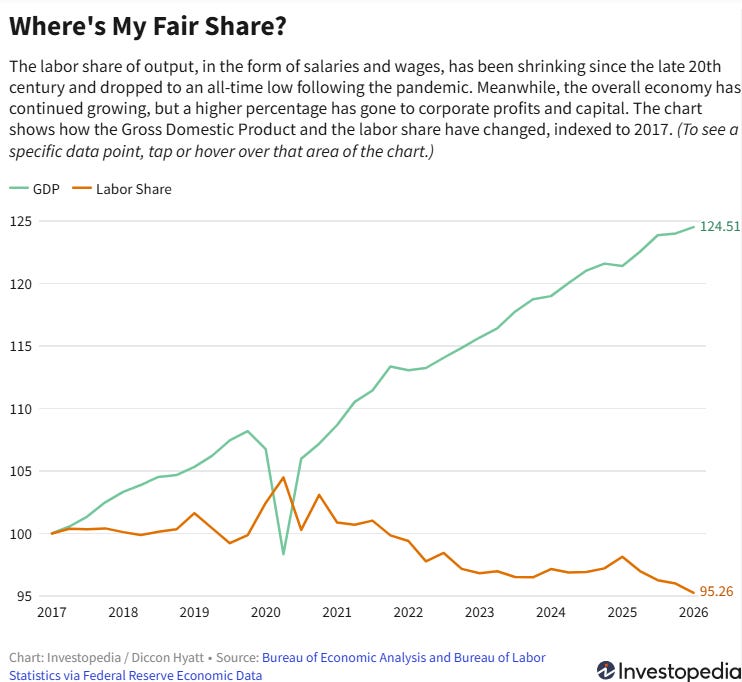
This is the K-shaped reality wage earning Millennials and Gen Z Zoomers must navigate in an economy now fully under the control of the supply side. Their prospects are unlikely to change as long as investors flush with capital continue to pour hundreds of billions into the ultimate source of labor insecurity—artificial intelligence.
Sold as a “revolution in productivity,” Silicon Valley’s latest disruptive tech has yet to deliver on its tantalizing promise of a “frictionless” economy managed by agentic AI instead of human beings. Silicon Valley says this will benefit all, but make no mistake, the market’s latest, perhaps greatest speculative bubble is being blown by and for those who do not earn wages. Instead, they fund their lifestyles with tax-free income drawn in the form of loans against the rise in the value of their stock portfolios. That source of income isn’t simply outpacing inflation, it is leaving it in the dust. It allows them to swoop in with all-cash offers on homes, pay exorbitant prices for food at upscale grocers and fly in luxury. They can also afford to pour billions into elections, into survivalist bunkers and, for the supply side’s biggest winners, into space travel.
Unlike many Millennials and Zoomers, they do not have to move into their parents’ basement in a bid to save for a down payment or first-and-last month’s rent.
Instead, they are moving into cities and towns and rural communities to hyperscale the data centers that, if successful, could very well put millions of wage earners out of work. And even if AI fails to deliver in the long run, the looming threat of tech-driven job losses will slather the economy with Greenspan’s secret sauce for the foreseeable future. It portends a particularly bleak tomorrow for younger Millennials and Zoomers who, as The Center for Economic Policy and Research recently explained, are losing ground:
The median net worth for households under the age of 35 fell by 23 percent (from $44,700 to $33,000) between 2022 to 2025, according to the most recent data release from the Federal Reserve’s 2025 Survey of Consumer Finances (SCF).
Is it any wonder why only 9% of Zoomers and 15% of younger Millennials have a positive view of “capitalism”?
It’s even more explicable given the fact that, unlike their Boomer and Gen X parents, they were born into and came of age in a supply side economy that is foreclosing the American Dream and jamming a potentially job-killing technology down wage earners’ throats.