


The American people are pissed off.
Throughout many months of midterm campaigning, the purveyors of conventional wisdom have rested assured that voters’ anger is motivated primarily by affordability, inflation and the Iran war-stoked “price of gas.”
And it makes sense.
America’s elections often turn on “kitchen table/pocketbook” issues like inflation, jobs and the cost of healthcare. It’s why we still refer to “It’s the economy, stupid” thirty-four years after the Clinton campaign made it their mantra. Predictably, the polling repeatedly confirmed throughout the summer that the midterms would indeed be another “It’s the economy, stupid” election.
Then, in the campaign’s final weeks, the well-respected pollsters at FOX News revealed the biggest surprise of the midterms—corruption suddenly leapfrogged to the top of voters’ concerns, outpacing the economic struggles that have increasingly dominated the political discussion since the pandemic derailed the global economy back in 2020:
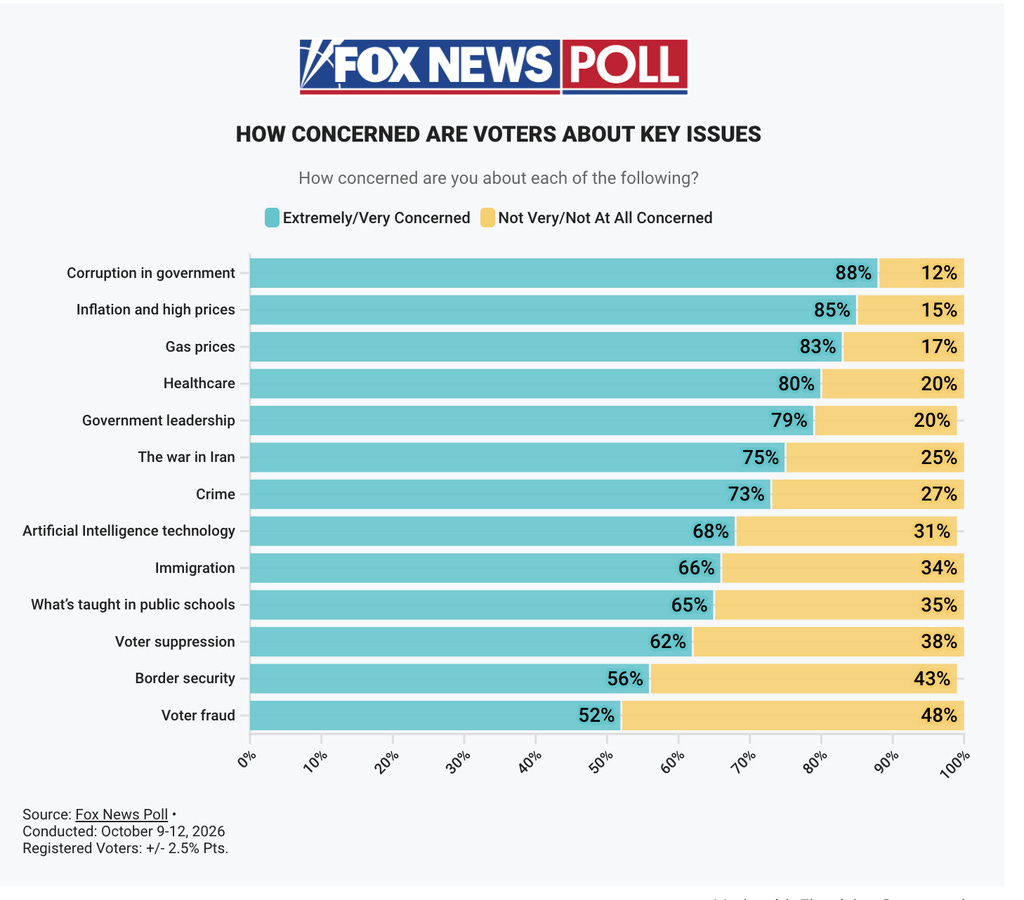
After nearly ten years of cronyism, bribery and unabashed self-dealing, an overwhelming 88% of Americans are finally fed-up with the plundering of the presidency.
That’s nearly nine out of ten.
A number that high has to be bipartisan and include a significant number of unaffiliated independents. It must also include some disaffected Trump voters who’ve finally revoked the blanket immunity they granted him for most of the last ten years. The GOP cannot afford to lose those voters if they hope to retain the Senate. Even worse for them, the issue of corruption is also a late-breaking trend that was subsequently echoed in polls by CNBC and The Guardian. It’s not unlike the end of the 2016 campaign when the late movement trended away from Hillary and toward Trump. The GOP desperately needs late-deciding voters to break their way again, if only to limit their losses.
Therein lies the rub.
Convincing those voters with a last-minute barrage of erroneous, histrionically delivered fearmongering may be a stretch when inflation-battered voters—who’d already cast 51 million votes three days before election day—are now putting corruption at or near the top of their concerns. Unfortunately for the GOP, it probably means they’ve been paying attention to more than just the price of gas.
Republicans should brace for a long night if voters are indeed motivated by the stench of corruption wafting off the Epstein Files, tariff-related insider trading, the blatant oil profiteering, Kimberly Guilfoyle’s extortion, the murky world of insider-like trading on the two leading, Don Jr.-linked prediction markets and the $4 billion crypto fortune Trump amassed during his first year back in office.
It’s that last one that might present the biggest problem.
Voters have watched Silicon Valley become increasingly powerful as they’ve embraced Trump and stuffed his pockets with millions of dollars for his inauguration, his military parade, his ballroom, his wife’s movie and, whether directly or indirectly, his cryptocurrency businesses.
Mostly, they’ve watched Trump deliver returns on Silicon Valley’s investment in his plunderbund. It’s been a potent cocktail of regulatory indifference, government assistance and Trump’s patented salesmanship. He’s the Valley’s leading product pitchperson. He’s been hired to promote the Valley’s unpopular and potentially dangerous AI agenda. But I suspect voters are connecting Trump’s ongoing, tech-related windfall with his “see, hear and speak no evil” policy on artificial intelligence … which he is also trying to rebrand on their behalf.
They are definitely coming face-to-face with the potentially job-killing AI being cooked-up in the noisy, resource-sucking, pollution-spewing data centers currently popping up like mushrooms around the nation. In response, Americans around the nation and across the political spectrum have been making their displeasure known at city council meetings and county commissioner hearings. The anger has been mounting throughout the summer and, like the issue of corruption, it appears to be peaking as the nation gets closer to election day.
On any given day I can go to the Google machine and find new reporting on new efforts to ban or restrict data centers at the state, county or municipal level. Here’s a sampling of what I found just over the last three days of October:
Data center developer sues Pulaski County over new regulations (Arkansas)
https://katv.com/news/local/data-center-developer-sues-pulaski-county-over-new-regulations
EXCERPT: A company developing a proposed data center in Pulaski County has filed a federal lawsuit challenging new county regulations, alleging the ordinance unfairly targets its project and was approved following improper communications among local officials.
Urbana data center: What happens if the charter amendment and proposed settlement pass? (Illinois)
https://www.springfieldnewssun.com/local/urbana-data-center-what-happens-if-the-charter-amendment-and-proposed-settlement-pass/article_3820c658-ed1b-5510-9a30-2106f5413689.html
EXCERPT: Citing a lack of transparency from Mayor Bill Bean and the city council, residents launched petitions this past summer to recall the mayor and ban future data centers.
City council has since passed an ordinance placing the proposed charter amendment to ban data centers on the November ballot.
Estherville Planning and Zoning Commission advances data center ordinance recommendations to city council (Iowa)
https://www.ktiv.com/2026/10/30/estherville-planning-zoning-commission-advances-data-center-ordinance-recommendations-city-council/
EXCERPT: The commission considered and approved several restrictions, including capping any data center at a 25-megawatt facility, minimizing environmental impacts, placing limits on noise, and managing infrastructure such as municipal water and electric power consumption.
Settlement reached in Pine Island data center lawsuit (Minnesota)
https://www.kaaltv.com/news/settlement-reached-in-pine-island-data-center-lawsuit/
EXCERPT: According to the release, as part of the settlement, the proposed data center will be the first in Minnesota to undergo a new state environmental review process.
Data center proposed for public land south of Shoshone (Montana)
https://www.mtexpress.com/news/state_regional/data-center-proposed-for-public-land-south-of-shoshone/article_d2665288-8689-4684-b575-aa31ac9c8d5d.html
EXCERPT: The Blaine County Board of Commissioners earlier this month unanimously approved enacting a 182-day emergency moratorium on the issuance of development permits for data centers.
The ordinance disallows county officials from the “receipt, processing and approval of applications” of permits for the construction of data centers in Blaine County for the six-month period, the maximum permitted by law.
The emergency moratorium also mandates that county officials develop a plan for a “permanent solution” to a list of numerous “problems” associated with data centers, including the developments’ typically industrial-scale consumption of water and energy.
Chatham County Commissioners approve two items in special meeting on data centers (North Carolina)
https://www.wral.com/news/local/chatham-county-commissioners-approve-two-items-special-meeting-data-centers-/
EXCERPT: In February, Chatham County adopted a temporary moratorium on data centers. Chatham County residents, along with the nonprofit Haw River Assembly, said on Wednesday that they are pushing for a statewide moratorium on building data centers.
Ohio ‘brothers’ look to disrupt data center blitz one town at a time
https://www.politico.com/news/2026/10/30/distaste-for-data-centers-brings-bipartisan-ballot-blitz-to-ohio-01140681
EXCERPT: Ohio has emerged as a data center hot spot. A report last month from real estate firm Cushman & Wakefield identified the Columbus area — and specifically suburban New Albany — as among the most active markets.
The report notes, however, that political and regulatory scrutiny is prominent and “local opposition is also intensifying.”
Piqua, Ohio, a city of about 20,000 people a half hour north of Dayton, is one example. There, social media giant Meta is planning a $1 billion data center codenamed Project Klondike on just over 600 acres. Many residents are unhappy with how it unfolded.
A proposal in Lower Merion would restrict data centers to a formerly industrial Bala Cynwyd corridor (Pennsylania)
https://www.inquirer.com/news/pennsylvania/lower-merion-data-center-regulations-20261030.html
EXCERPT: The facilities would be capped at 60 feet in height and would need to be 1,000 feet away from any residential zoning district. The facilities would be required to use a closed-loop cooling system.
The proposed ordinance also sets requirements for thermal impact mitigation, noise studies, water and wastewater capacity studies, drought response plans, and public engagement, and mandates developers provide a decommissioning plan for safely shutting down and removing all equipment should a data center cease operations.
Dauphin County township moves to get ahead of data center development with ordinance (Pennsylania)
https://www.pennlive.com/news/2026/10/dauphin-county-township-moves-to-get-ahead-of-data-center-development-with-a-targeted-ordinance.html
West Conshohocken Data Center Bid Faces Borough’s New Zoning Rules (Pennsylania)
https://philadelphia.today/2026/10/west-conshohocken-data-center-brian-oneill/
Was reaction to a potential data center near Old Town San Diego overblown? (California)
https://www.sandiegouniontribune.com/2026/10/30/was-reaction-to-a-potential-data-center-near-old-town-san-diego-overblown/
San Antonio restricts data centers, requires council approval on new projects (Texas)
https://www.ksat.com/news/local/2026/10/29/san-antonio-restricts-data-centers-requires-council-approval-on-new-projects/
Gainesville residents call for 12-month pause on data center applications (Virginia)
https://www.potomaclocal.com/2026/10/30/gainesville-residents-call-for-12-month-pause-on-data-center-applications/
An inside look at the massive data center tearing a Wisconsin community apart
https://www.npr.org/2026/10/25/nx-s1-6011201/data-center-wisconsin-midterms-port-washington
EXCERPT: Port Washington’s gargantuan project has led to angry protests, multiple lawsuits, and opponents arrested for civil disobedience. Supporters say data centers will keep the United States competitive and could bring great wealth to places where they’re built. But many residents feel frightened and helpless as they watch this rapid change
Remember, that’s just a sampling of the sample I gathered from the last three days of October, but I’ve seen and compiled these stories for many months. A similar backlash over Flock surveillance cameras also took off around Labor Day and, like the data centers Trump defended despite his base’s growing unease, he embraced the use of unpopular cameras.
It was yet another disappointment for MAGA supporters who harbor a deep suspicion of government … which he cultivated and exploited on the way to two terms in office. Now that skepticism is being turned on him and his party as he turns away from the concerns of his devotees and focuses instead on the demands and desires of his true constituents … the deep-pocketed tech broligarchs he proudly hosted at the White House just a few months ago.

We won’t know what role the data center backlash will play in the impending election until we start to see exit polling. The same goes for turnout. But there’s little doubt that data centers, AI and Trump’s no holds barred approach to regulation has sparked a strong reaction among Americans who are not in alignment on the two party’s “us or them” wedge issues. Perhaps that’s because it is happening on the ground in the places where people have to live with the consequences of Trump’s national push for AI.
Its that linkage I will be looking for when the exit polls are analyzed. If data centers do play a role and voters did make the link between government corruption and the effort to jam AI down their throats, it may signal the start of a larger social and political rejection of Silicon Valley’s parasitic business model. They want their AI to make itself indispensable before the political system can get past Trump and reign it in. But the counter-movement is throwing sand into the gears and it’s having an impact. Bloomberg reported on a new analysis by S&P Global Ratings that “tracked 146 delayed or canceled projects in the US” and found “about three-quarters of them were tied to local pushback.” All told, “local governments across 40 states” have imposed bans and “delays due to grid capacity constraints, environmental sustainability concerns and zoning shift” threaten to exert “downward pressure on the creditworthiness of data center projects.”
In other words, the public’s reaction is starting to make some of these data centers a bit too risky. On the flipside, Americans may be waking up to a corrupt system that buys off “leaders” and, with their assistance, privatizes gains and socializes the costs, much like the water and energy use that’s driving up utility bills around data centers.
We already know one thing for certain … AI’s pushers are well-aware that they’ve got a growing problem on their hands. Their solution? Here’s Axios with the “scoop”:
Right after Tuesday's midterms, OpenAI will unleash a policy and PR blitz to try to get in sync with the new Washington, including an effort to rebrand data centers as "AI compute campuses."
Sure, that’ll do it. Just call AI “superintelligence,” and call data centers “compute campuses.” And if a hamfisted Jedi Mind Trick is the only thing they have up their sleeves, I’d advise them to call their lawyers because they’re about to spend an inordinate amount of time and energy responding to summons and subpoenas.